

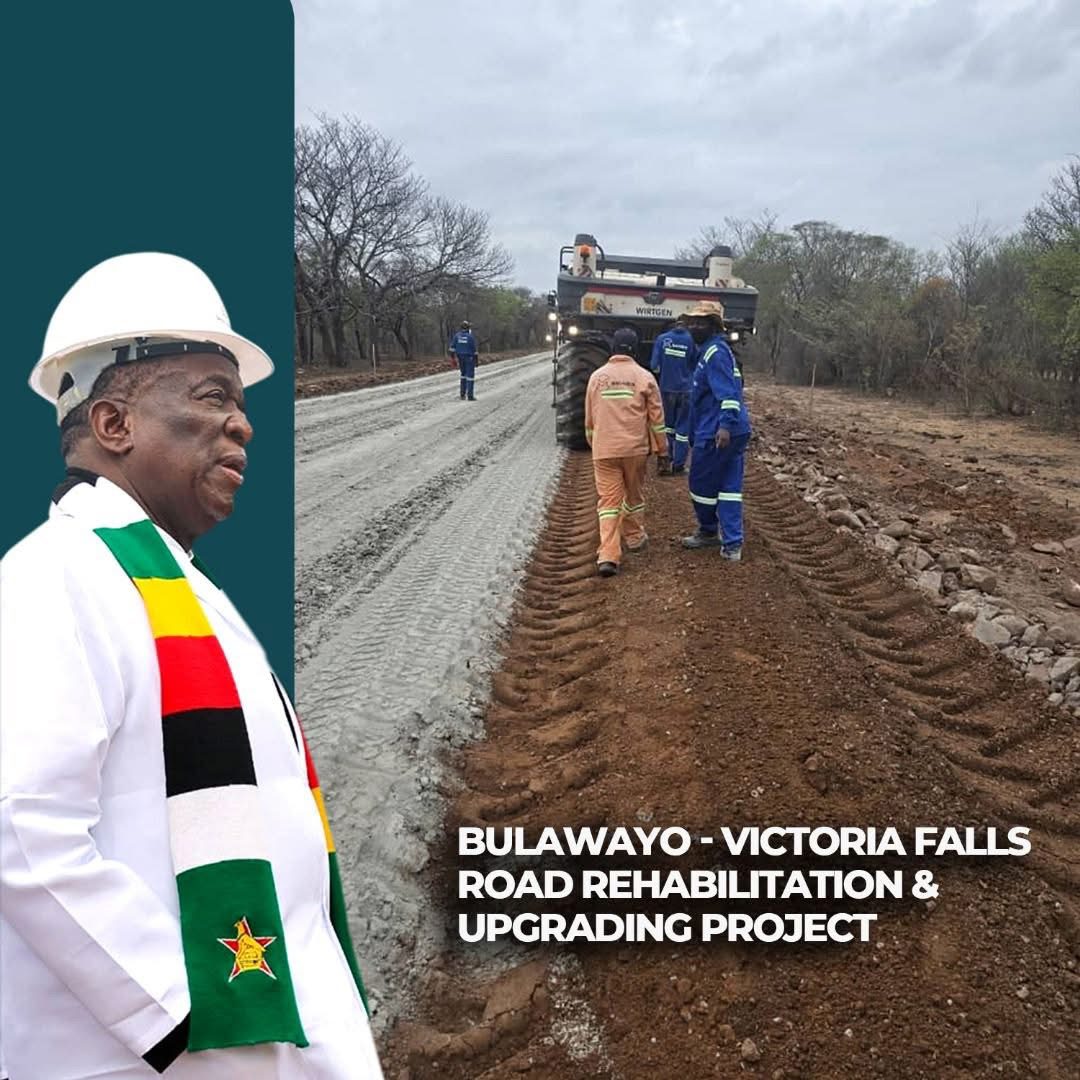
The long-awaited upgrade of the Bulawayo–Victoria Falls highway has reached a key technical stage, marking a significant step forward in one of Zimbabwe’s most strategic infrastructure projects.
Cement stabilization works are now in progress in the Insuza section, signaling a new phase focused on building a stronger, more durable road that will better serve the nation’s tourism and trade sectors for decades to come.
The Bulawayo–Victoria Falls highway, stretching approximately 440.4 kilometers, is a lifeline linking Zimbabwe’s second-largest city to its premier tourism destination—Victoria Falls, one of the Seven Natural Wonders of the World.
It is also a critical artery for trade and transport within the Southern African region, connecting Zimbabwe to Zambia, Botswana, and Namibia through the regional transport corridor.
According to the latest technical progress report, 19.2 kilometers of the road have already been completed and commissioned—about 4.4% of the total scope.
The remaining 421.2 kilometers, representing roughly 95.6%, are under active construction and phased development.
Though much remains to be done, engineers on the ground are reporting steady momentum as work crews advance section by section, prioritizing foundation strength and material longevity.
Cement stabilization—the process currently underway—is a cornerstone of this progress. In this method, cement is blended into the existing soil along the road base to increase its strength and load-bearing capacity.
The technique ensures that the subgrade, or foundation layer, can sustain the heavy traffic loads typical of the Bulawayo–Victoria Falls route, especially from freight trucks, tour buses, and local transport vehicles.
By using cement stabilization, engineers are laying down the groundwork for a highway that not only meets modern standards but also resists weather-related wear and tear.
Once the stabilized layers are compacted and cured, they form a rigid, long-lasting foundation capable of supporting the asphalt surfacing that will follow.
The project goes beyond just road repair—it is a major investment in Zimbabwe’s future.
The Bulawayo–Victoria Falls corridor is a vital link between key economic zones, facilitating the movement of goods, services, and tourists across national and regional boundaries.
For tourism, the benefits are immediate and long-term. The upgraded road will drastically improve travel time and safety for visitors heading to Hwange National Park, the Binga resort area, and the world-renowned Victoria Falls.
With smoother surfaces, reduced vehicle damage, and shorter travel durations, the entire tourism value chain—from hotels to tour operators—stands to gain.
Economically, the rehabilitation enhances trade logistics by making freight transport more efficient.
The road forms part of a regional route that connects to the Kazungula Bridge, creating a direct corridor for goods moving between Zimbabwe and neighboring countries.
Improved road infrastructure is expected to lower transportation costs, support small-scale traders, and open up new opportunities for rural communities along the route.
Government officials overseeing the project have consistently emphasized that infrastructure rehabilitation is central to Zimbabwe’s Vision 2030 agenda, which seeks to transform the country into an upper-middle-income economy.
Roads, they note, are not just physical assets—they are enablers of development.
The ongoing Bulawayo–Victoria Falls upgrade is being implemented in phases, reflecting a careful balance between technical execution and financial sustainability.
Each completed kilometer marks progress toward a more connected and economically vibrant Zimbabwe.
An official close to the project described the initiative as “a statement of resilience and renewal,” adding that “every section rehabilitated represents not only better transport infrastructure but a renewed confidence in national capacity and engineering excellence.”
Project engineers have emphasized that the rehabilitation work adheres to international standards of road design, environmental management, and safety.
The cement stabilization process minimizes the need for large-scale soil replacement, reducing environmental impact while maintaining structural integrity.
Road rehabilitation teams are also ensuring that local communities benefit through employment and procurement opportunities.
Contractors have engaged local labor for site clearing, soil preparation, and logistics support—an approach that spreads the economic benefits of the project beyond its immediate technical scope.
Safety remains a top priority. Temporary detours and clear signage have been set up to guide motorists through active construction zones.
The public has been urged to exercise caution, observe speed limits, and cooperate with on-site personnel to minimize disruption.
As of this latest update, focus remains on the Insuza section, where cement stabilization is expected to be completed before the onset of the rainy season.
Once this stage concludes, crews will proceed with base-layer compaction, asphalt surfacing, and line marking—key steps toward delivering a fully rehabilitated stretch ready for commissioning.
Officials have also hinted that upcoming project phases may see expanded collaboration with private contractors and development partners to accelerate completion timelines.
With steady funding, reliable equipment supply, and favorable weather, projections suggest that significant portions of the remaining 421.2 kilometers could be completed over the next few years.
Beyond statistics, this project is about national progress and collective determination.
Each kilometer built represents improved safety for families, reduced costs for businesses, and better access for tourists exploring Zimbabwe’s wonders.
From the rolling plains of Matabeleland North to the thunderous spray of the Victoria Falls, the rehabilitated road will reconnect people, culture, and commerce—restoring the artery that binds Zimbabwe’s heartland to its crown jewel of tourism.
The project’s tagline, “Kilometer by Kilometer, We Build the Future,” encapsulates the spirit of persistence guiding the endeavor.
It is a message of confidence in the country’s ability to modernize through steady, visible, and meaningful development.
As crews work under the African sun, shaping the ground that will carry millions of travelers in years to come, the Bulawayo–Victoria Falls Road Rehabilitation Project stands as a testament to national willpower and vision.
It reminds Zimbabweans that progress does not come overnight—it comes kilometer by kilometer, through dedication, planning, and unrelenting belief in the road ahead.