

…a New Chapter in African Industrialisation
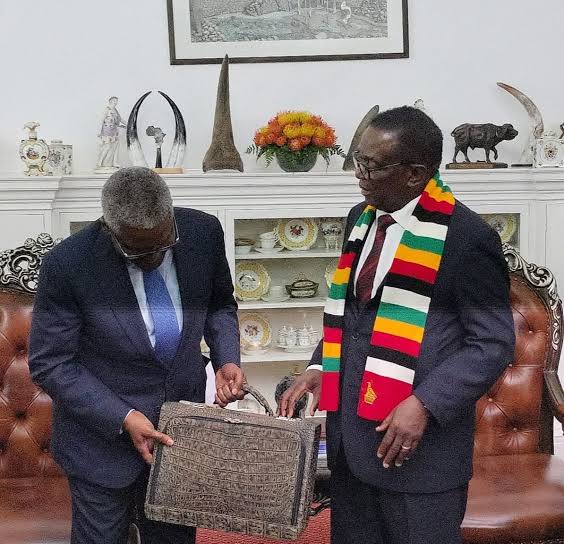
Africa’s wealthiest businessman, Aliko Dangote, met with President Dr. Emmerson Dambudzo Mnangagwa at State House in Harare today to discuss a potential US$1 billion investment package covering cement manufacturing, coal mining and power generation.
The Nigerian billionaire and industrialist, who heads the Lagos-based Dangote Industries Limited, presented his detailed investment proposals to the President during the high-level engagement, marking a significant step toward what could become one of Zimbabwe’s largest private-sector partnerships.

Government officials described the meeting as “highly productive” and noted that Dangote reaffirmed his confidence in Zimbabwe’s economic reforms under the Second Republic.
According to the proposals tabled, Dangote Industries plans to establish a fully integrated cement factory, a limestone quarry and grinding plant, a coal mine, and a power station to support both the industrial facilities and the national grid.
The total investment is projected to range between US$800 million and US$1 billion.
The discussions come at a time when Zimbabwe is intensifying efforts to attract large-scale investment to revive its manufacturing base and strengthen energy security.
The proposed projects directly align with the goals of Vision 2030, the country’s blueprint for achieving upper middle-income status through industrialisation, infrastructure development and employment creation.
Speaking after the meeting, senior government sources said President Mnangagwa welcomed Mr. Dangote’s initiative and assured him of Zimbabwe’s readiness to facilitate his projects through the Zimbabwe Investment and Development Agency (ZIDA).

“The President expressed his appreciation for Mr. Dangote’s interest in Zimbabwe and reaffirmed his government’s commitment to creating a predictable, investor-friendly environment,” said an official familiar with the discussions.
If implemented, the projects are expected to create thousands of jobs during both the construction and operational phases, while enhancing Zimbabwe’s capacity in cement production, mining and energy generation.
Aliko Dangote’s business empire is one of the most diversified and successful on the African continent. Dangote Industries Limited has interests in cement, sugar, salt, flour, pasta, beverages, fertiliser, oil and gas, real estate and logistics. It operates in 17 African countries, employing tens of thousands of people.
The group’s largest subsidiary, Dangote Cement, has factories and grinding plants in Nigeria, Cameroon, Ghana, Senegal, Sierra Leone, Ethiopia, South Africa, Zambia, Tanzania, and the Republic of Congo.
The company dominates Africa’s cement market and is known for driving self-sufficiency in building materials across the continent.
Dangote Industries is also behind Africa’s largest oil refinery and petrochemical complex, located in Lagos, Nigeria, which has been hailed as a transformative project for the continent’s energy independence.
“Zimbabwe presents a promising frontier for our expansion strategy,” Mr. Dangote noted in an earlier conversation about his regional ambitions.
“We are committed to supporting Africa’s industrial growth through sustainable investment and collaboration.” He said.

The planned cement factory and limestone quarry will be crucial for meeting Zimbabwe’s growing infrastructure and construction needs. Domestic demand for cement has been rising in line with national housing projects, road construction and urban development.
Economists say the entry of Dangote Cement could help stabilise prices, improve supply and introduce new efficiencies into the local market.
The addition of a coal mine and power generation facility will also strengthen Zimbabwe’s energy supply chain, helping to reduce dependence on imported power and ease pressure on existing plants.
“Dangote’s proposed power station is a game-changer,” said economic analyst Tatenda Moyo. “It will not only supply his operations but could contribute surplus electricity to the national grid, which is essential for industrial recovery.”
The coal mining component, meanwhile, is expected to tap into Zimbabwe’s vast coal reserves, particularly in the Hwange area, supporting both energy production and downstream industries.
Since assuming office, President Mnangagwa has pursued aggressive reforms to improve the investment climate, ease of doing business, and infrastructure development.
His “Zimbabwe is Open for Business” policy has attracted renewed interest from investors across Africa, Asia and the Middle East.
Dangote’s visit and direct engagement with the Head of State underscore growing investor confidence in Zimbabwe’s economic trajectory.
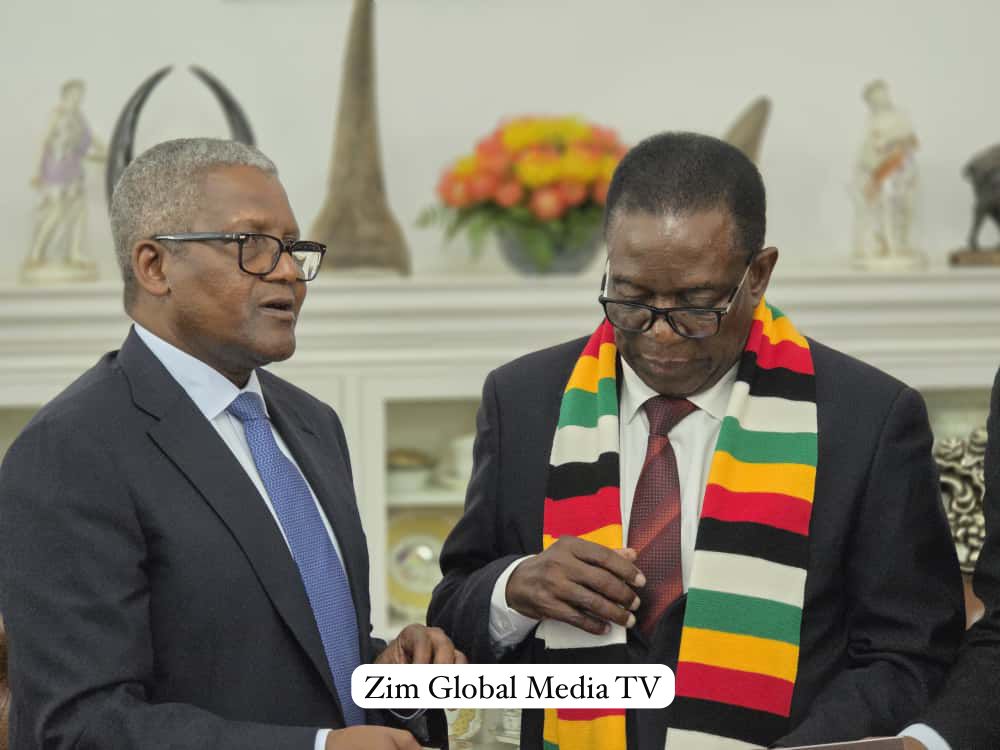
For the government, the meeting reflects tangible progress in its efforts to attract credible, high-impact investors.
“The arrival of Mr. Dangote today and his detailed presentation to the President show that Zimbabwe is being noticed by serious investors,” said a senior economic advisor.
“This is not speculative interest—it’s strategic, long-term investment anchored on Zimbabwe’s resources and industrial potential.” The advisor added.
Dangote’s move into Zimbabwe also represents a broader shift toward intra-African investment and collaboration.
For decades, African countries have relied heavily on capital from outside the continent.
As African conglomerates like Dangote Industries expand regionally, a new model of pan-African industrialisation is taking shape.
This shift is reinforced by the African Continental Free Trade Area (AfCFTA), which seeks to create a single market for goods and services across the continent.
Zimbabwe’s partnership with Dangote Industries could serve as a practical example of how African capital and expertise can be mobilised to build industries from within.
“Investments like this redefine what it means to do business in Africa,” said business consultant Memory Chigumbura.
“They show that African entrepreneurs can be the architects of their continent’s transformation, not just participants in it.” Chigumbura added.
Following today’s meeting, technical teams from both the Government of Zimbabwe and Dangote Industries are expected to begin site assessments, feasibility studies, and environmental impact evaluations.
Possible project locations under consideration include parts of Matabeleland North, the Midlands and Mashonaland West provinces, all rich in limestone and coal deposits.
Once operational, the projects are expected to supply the domestic market and export surplus cement and power to neighbouring countries, positioning Zimbabwe as a regional industrial hub.
President Mnangagwa is understood to have assured Mr. Dangote of full government support, including facilitation through the “One-Stop Investment Centre” under ZIDA to expedite approvals and licensing.
Today’s meeting between President Mnangagwa and Mr. Dangote may well mark the beginning of a new chapter in Zimbabwe’s industrial story—one defined by African capital, collaboration, and confidence.
The potential US$1 billion investment represents more than economic figures; it embodies the shared belief that Africa’s growth must be led by Africans themselves.
For Zimbabwe, it offers both a practical boost to industrial recovery and a symbolic reminder of the country’s renewed position on the continental stage.
As the two leaders concluded their discussions, one thing was clear: the path toward Zimbabwe’s reindustrialisation is being redrawn not only through international partnerships but through the strength of African enterprise and shared purpose.