

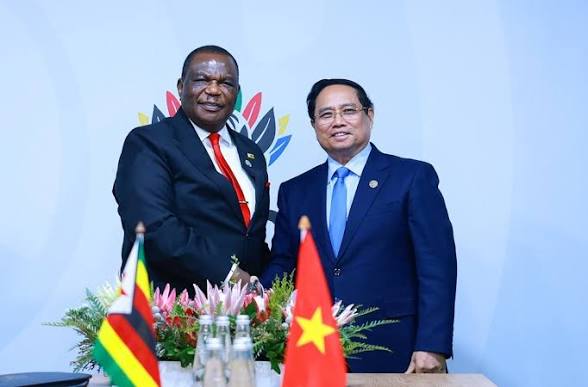
Johanesburg, South Africa – Vice President Rtd General C.G.D.N. Chiwenga’s powerful statement to the G20 as he represented the President His Excellency Dr. ED. Mnangagwa has quickly become one of the clearest reflections of Zimbabwe’s disciplined, strategic and future-focused development outlook under President E.D. Mnangagwa and the Second Republic.
What he delivered was not simply a formal address, but a firm declaration of how Zimbabwe intends to navigate the rapidly shifting terrain of global economics and politics. It carried the steady tone of a nation that is no longer pleading for space at the table, but confidently asserting its place in the emerging world order.
From a development economics point of view, the Vice President laid out a blueprint that signals the maturing of Zimbabwe’s long-term vision. His remarks stood on the pillars that guide the country’s march toward Vision 2030: value-addition, human-capital development, governance reforms and climate resilience. Each of these themes speaks to a country that understands the weight of its own potential, and more importantly, the discipline required to convert potential into measurable progress.
Value-addition has become a recurring theme in Zimbabwe’s national economic agenda, yet Chiwenga’s delivery gave it fresh urgency. He spoke as a man who understands that exporting raw commodities is a path to stagnation, not prosperity. The call to industrialise is no longer a mere aspiration but an economic necessity. By placing beneficiation at the centre of Zimbabwe’s growth strategy, he aligned the country with the development trajectories of nations that lifted themselves from poverty through manufacturing, innovation and competitive exports. In this, Zimbabwe is not simply adjusting to the winds of global change but setting its sails toward deliberate, structured advancement.
Human-capital development featured prominently in his reflections, grounding the idea that any sustainable transformation must be driven by a skilled, adaptive and empowered population. Zimbabwe’s long-standing reputation in education is not enough on its own. What Chiwenga articulated is a sharpened focus on linking education to industry, science to production, and young talent to real economic opportunity. This is the kind of thinking consistent with both Vision 2030 and the African Union’s Agenda 2063, putting Zimbabwe firmly within the continental movement toward inclusive, innovation-led growth.
Governance reforms were presented not as slogans but as practical commitments. The Vice President’s tone echoed the Second Republic’s push for transparency, institutional strengthening, and a modernised regulatory framework. These reforms are not just internal housekeeping; they are the currency through which global investors, lenders and partners measure Zimbabwe’s readiness to participate meaningfully in the global economy. In emphasising reform, Chiwenga projected a nation determined to rebuild trust and demonstrate reliability on the world stage.
He also addressed climate resilience with a clarity that felt both urgent and pragmatic. Zimbabwe, like much of Africa, bears the heavy cost of climate-induced droughts, floods, and agricultural disruptions. Yet Chiwenga’s message carried no hint of resignation. Instead, he put forward the idea that green growth, renewable energy, and climate-smart agriculture are not optional—they are central to the country’s long-term survival and prosperity. This aligns Zimbabwe with global environmental priorities while also protecting the livelihoods of millions who rely on land and water.
If the economic portion of his address felt like a disciplined roadmap, the global political dimension had the unmistakable force of a country stepping into a more assertive diplomatic identity. Chiwenga pushed firmly for the reform of global financial systems that have long disadvantaged developing nations. His call for a fairer multilateral order was not couched in rhetoric, but in reasoned argument. He spoke with the calm intensity of someone who has seen how global inequality is reinforced by outdated structures, and who now demands change not as charity, but as justice.
One of his strongest points was the need for the recapitalisation of development banks. This is a message that resonates across the Global South, where access to affordable long-term financing remains a barrier to growth. By pushing for larger, better-resourced multilateral institutions, Zimbabwe aligns itself with the broader struggle to democratise global development financing.
The Vice President also highlighted innovative financial tools that could help countries like Zimbabwe break free from debt cycles while still investing in their futures. Green bonds, diaspora capital mobilisation, and debt-for-climate swaps were among the instruments he put forward. These proposals showed a deep understanding of modern finance and an eagerness to embrace solutions that blend environmental responsibility with economic empowerment.
His call for Zimbabwe’s inclusion in an improved G20 debt framework carried a tone of confidence that reveals just how far the country’s diplomatic posture has evolved under President Mnangagwa’s re-engagement policy. No longer is Zimbabwe speaking from the margins. It is speaking from within the global conversation, offering ideas, demanding fairness, and signalling readiness to participate in structured financial reform. This is the voice of a state that has rebuilt its diplomatic muscles and is now prepared to use them.
Across the board, Chiwenga’s address painted Zimbabwe as a responsible, reform-driven nation committed to both domestic transformation and global cooperation. It reinforced the impression of a country determined to rise through industrialisation, digital transformation, and inclusive growth. His message was simple but powerful: Zimbabwe is not waiting to be rescued by global powers. It is crafting its own path, guided by the discipline of the Second Republic and the long-term ambitions of Vision 2030.
Politically, his intervention also strengthened ZANU PF’s credibility on the international stage. It reminded observers that the governing party’s economic agenda is rooted in real policy, not political performance. The mix of economic strategy, diplomatic maturity, and climate responsibility presented in his address demonstrated that Zimbabwe’s leadership understands the new global realities and is preparing the country to meet them head-on.
In the end, the Vice President delivered more than a statement. He delivered a signal to the world that Zimbabwe is stepping into a new era, one marked by disciplined planning, honest reform and determined engagement. His words captured the quiet momentum building within the nation, the sense that despite challenges, Zimbabwe’s story is far from finished. In fact, it may just be entering its most promising chapter yet.