


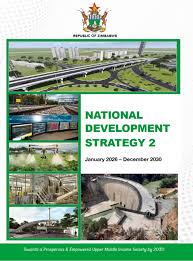
Zimbabwe stepped into a decisive new chapter yesterday as His Excellency President Dr Emmerson Dambudzo Mnangagwa officially launched the National Development Strategy 2, the blueprint that will guide the nation from 2026 to 2030.
The launch, held at State House in Harare, brought together Government officials, diplomats, industry leaders and development stakeholders, all gathering with a shared expectation that the country is ready to accelerate its transformation toward Vision 2030.

NDS2 arrives at a crucial moment, carrying the weight of national aspirations. It is built to consolidate the progress of NDS1 and push the country deeper into economic modernisation, value chain development, social upliftment and institutional strengthening. The document is bold, highly structured and anchored on evidence drawn from Zimbabwe’s first-ever National Economic Census of 2024, which measured the real size and structure of the economy in both the formal and informal sectors. 
At the heart of the Strategy lies a clear ambition: to propel Zimbabwe into a Prosperous and Empowered Upper Middle-Income Society by 2030. This vision rests on the remarkable strides achieved during NDS1, where the economy grew at an annual average of 5.6 percent, exceeding the 5 percent target.  Agriculture, mining, manufacturing and tourism helped drive this recovery, even in the face of global shocks, tight international financial conditions and the lingering effects of the COVID-19 pandemic. 
Launching the Strategy, President Mnangagwa emphasised continuity, discipline and national unity. He spoke with humility and resolve, calling on all Zimbabweans to work together, “brick by brick and stone upon stone,” to build the future the nation seeks. The President reminded the audience that Vision 2030 is not merely a Government aspiration but a collective national duty grounded in the philosophy: “Nyika inovakwa nevene vayo.” 
The Strategy outlines ten national priorities, reduced from fourteen under NDS1, to sharpen focus and intensify delivery. These priorities span macroeconomic stability, infrastructure growth, human capital development, digital transformation, value addition, environmental sustainability, governance, devolution and social protection.
Each priority area is tied to measurable indicators under the Integrated Results-Based Management system, ensuring that progress is closely monitored. 
A major pillar of NDS2 is inclusive economic growth. Government acknowledges that while the economy expanded under NDS1, inequalities widened, with the Gini coefficient rising from 0.44 in 2021 to 0.50 in 2025.  NDS2 therefore repositions economic policy to ensure that growth benefits everyone. The Strategy advances inclusive participation, fair access to opportunities, rural industrialisation, and targeted support for women, youth and vulnerable communities. It aims to create a competitive, diversified economy where growth trickles down equitably across society. 
Agriculture, the backbone of Zimbabwe’s identity and food security, remains central. NDS2 focuses on irrigation expansion, climate proofing, mechanisation and value addition. One of the standout examples is the tobacco sector, where investment in Special Economic Zones will push value addition from 2 percent to over 30 percent through nicotine extraction technologies and advanced processing facilities. 
With Zimbabwe having produced a record 355 million kilograms of tobacco in 2025, valued at US$1.2 billion, the strategy seeks to transform the crop beyond raw exports and into high-value products that strengthen foreign currency earnings.
The timber and paper industry is also set for a revival. NDS2 outlines targets to increase domestic timber value addition from 25 percent to 60 percent by 2030, while reducing reliance on imported paper products and expanding downstream processing. The Strategy promotes reforestation, sustainable harvesting and modern industrial technology to transform local resources into competitive products.

Industrialisation and value chain development remain key themes throughout the document. Government aims to move the country away from raw material exports by leveraging the nation’s mineral wealth, agricultural output and skilled labour force. Structural transformation will focus heavily on beneficiation and manufacturing, thereby deepening linkages across sectors and generating broader economic opportunities. 
NDS2 places strong emphasis on macroeconomic stability. Zimbabwe’s experience under NDS1 showed that responsible fiscal management, policy consistency and discipline can anchor price stability and restore confidence. The new Strategy commits to strengthening coordination between fiscal and monetary authorities to maintain a stable exchange rate and predictable inflation environment. 
Human capital development is another strategic pillar. The Strategy calls for heavy investment in education, healthcare and skills training. It seeks to empower the workforce for a modern economy through STEM expansion, digital skills, vocational training and improved access to quality health services. 
Infrastructure development continues as a flagship focus. NDS2 aims to strengthen energy generation, modernise road and rail networks, expand digital connectivity and enhance water and sanitation systems. The Strategy insists that infrastructure is not an optional extra but a foundation for national competitiveness and social upliftment. Private sector participation, supported by reforms to improve the ease of doing business, will be central to this effort.
One of the most powerful elements of NDS2 is its commitment to national cohesion and governance reforms. The Strategy demands transparency, accountability and zero tolerance for corruption in the public sector. It calls for timely delivery of services, strong public institutions and a modern civil service that meets the expectations of an upper middle-income society. 
Brand Zimbabwe also receives special attention. Recognising the importance of image, communication and storytelling, the Strategy outlines plans to transform the media landscape, increase patriotic content production, expand broadcasting infrastructure and promote national achievements to both local and international audiences. 
As the launch concluded at State House, the sense of purpose was unmistakable. The President’s appeal for unity, discipline and collective responsibility echoed through the gathering. He urged all stakeholders, including the diaspora and cooperating partners, to support national efforts and accelerate the march towards Vision 2030. 
NDS2 is more than a policy document. It is a national statement of intent, built on evidence, optimism and a deep conviction that Zimbabwe’s future is firmly in its own hands.