

OPINION – There is a silent crisis unfolding across African classrooms, one so ordinary that many barely notice it anymore. A child sits at a desk, opens a textbook, and begins to learn about the world. But the world they meet is not their own. They are taught about European monarchs, explorers, revolutions and philosophers long before they ever encounter the story of the land beneath their feet. They learn the names of British kings, French generals and Portuguese sailors with impressive detail, yet struggle to name even one African queen, one African civilisation, one African intellectual tradition older than colonialism. This imbalance is not accidental. It is the lingering shadow of a curriculum designed long ago to shape African minds away from African self-confidence.
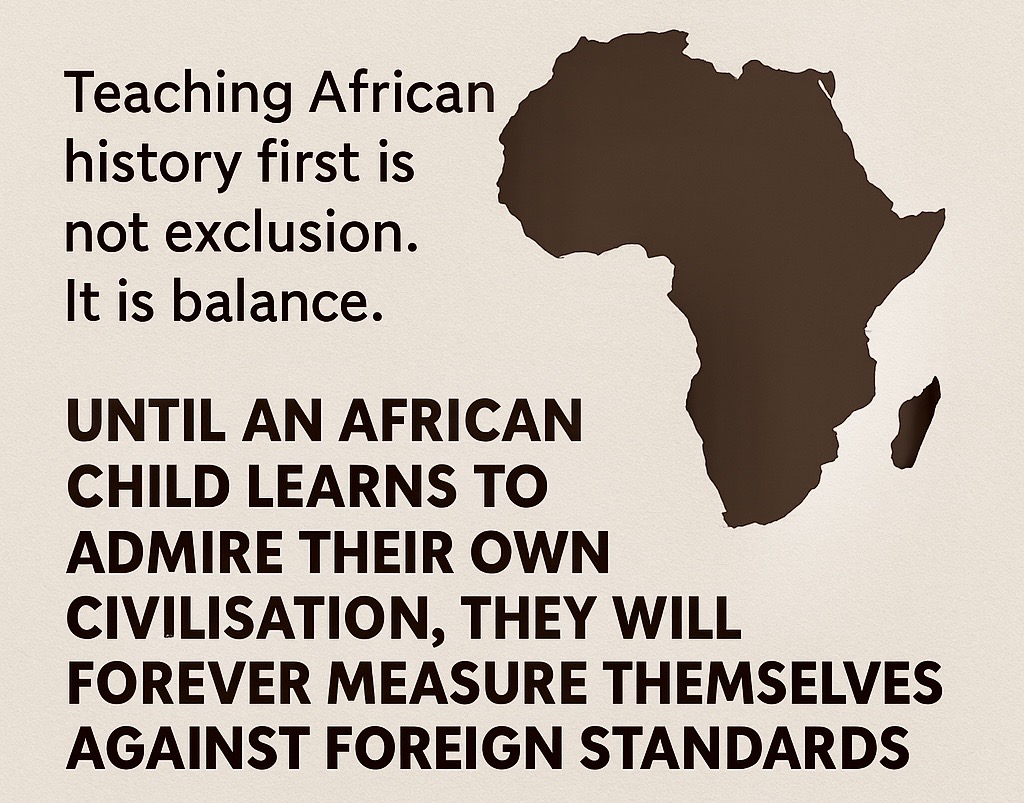
The consequences are deeper than many want to admit. A child who grows up learning that greatness lives elsewhere begins to internalise that belief. Without ever being told directly, they start to imagine that their own civilisation contributed little to the world. And from that early misunderstanding grows a quiet, unspoken inferiority complex that can last into adulthood. That is why the call for African history to be taught first is not a trivial debate. It is a matter of psychological liberation.
When a nation’s children know more about the Tudors than the Mutapa Empire, or more about Napoleon than Shaka, something has gone wrong. Education is supposed to shape identity. But in many African countries, the identity being shaped is one that looks outward for admiration and inward only for fault lines. Afrocentric scholars have warned about this for decades, but the message is gaining urgency now, as Africa watches its young people increasingly struggle with identity in a globalised world that often imposes hierarchy through culture and knowledge.
Teaching African history first does not mean closing the door on the rest of the world. It does not mean ignoring global history, European history or Asian achievements. It simply means correcting the imbalance. For too long, the African story has been treated as a footnote. And when you treat a people’s history as a footnote, you end up treating the people themselves the same way.
African children deserve to know that long before Europe industrialised, Africa was home to advanced states with complex governance systems, sophisticated economies and rich intellectual traditions. The Kingdom of Kush built monuments that still stand. Ethiopia was one of the earliest centres of Christianity and literacy. Great Zimbabwe demonstrates architectural ingenuity that continues to captivate historians. Timbuktu hosted scholars whose writings influenced knowledge beyond the continent. These were not tribal settlements lost in the fog of time. They were civilisations. They were nations. They were societies with their own logic, values and brilliance.
Yet many African students encounter these histories as afterthoughts, presented briefly and often with less seriousness than European content. This sends an unspoken message: this knowledge matters less. That message lands hard on a young mind searching for belonging.
If African history is taught first, the psychological effect is immediate and profound. A child learns that their ancestors were thinkers, builders, traders, astronomers, warriors, diplomats and philosophers. They learn that Africa produced governance systems suited to local realities, agricultural innovations shaped by climate and environment, and cultures rich in spirituality, art and collective ethics. They discover that their story did not begin with colonisation. In fact, colonisation was merely a violent interruption of a long civilisational journey.
This shift in teaching has implications beyond the classroom. A population grounded in its own history approaches development differently. It builds with confidence. It negotiates globally without feeling inferior. It invents with courage because it trusts its own intellectual heritage. It no longer sees itself as a continent catching up but as a continent continuing its story.
Critics sometimes argue that teaching African history first will isolate African students, or limit their global competitiveness. But this argument fails to recognise how other nations educate their youth. China teaches Chinese civilisation first. India teaches Indian civilisation first. Japan teaches Japanese civilisation first. And these nations are not isolated. They are global powers. Their children grow up with a sturdy cultural backbone that allows them to confidently engage the world without losing themselves in it.
Africa is the only continent that regularly teaches foreign history with more depth than its own. That is not global inclusion. That is historical imbalance. It is time to correct it.
By teaching African history first, African nations would also confront harmful stereotypes still embedded in global narratives. For decades, Africa has been portrayed as a continent without history, a narrative pushed by colonial leaders to justify domination. This lie has lived long enough. Teaching African history from the beginning helps dismantle the notion that Africa only entered history when Europeans arrived. It restores the dignity of pre-colonial societies and affirms that African modernity can be built from African memory.
There is also an economic argument. A child who understands that Africa produced iron long before many European states, that African agricultural systems sustained vast empires, or that African trade routes once controlled global commerce begins to understand the continent’s potential. They become more likely to embrace entrepreneurship, innovation and leadership driven by local context rather than imported assumptions. They recognise that Africa’s challenges are not rooted in cultural failure, but in historical disruption and global exploitation.
Furthermore, teaching African history first helps heal deep psychological wounds left by centuries of denigration. When a child learns that their ancestors were civilised long before Europe even recognised them, they begin to see themselves not as a people trying to prove their worth but as a people rediscovering it. That shift builds confidence, identity and ambition.
In the end, teaching African history first is about reclaiming narrative authority. It is about giving African children the dignity of seeing themselves reflected in the story of the world. It is about grounding them in their own roots before asking them to explore the forest of global history. No one builds a house starting with the roof. Foundation comes first. And for Africa, that foundation is African history.
If the continent is to rise with confidence, it must raise children who understand they come from greatness. Only then can they build a future worthy of that past.