
There is a sobering truth that has echoed across this continent from the days of Kwame Nkrumah, Julius Nyerere, Patrice Lumumba and countless other torchbearers of African liberation. It is a truth that still stares us in the face today, perhaps even more urgently than it did in the era of struggle. Africa cannot rise, Africa cannot prosper, Africa cannot protect its people, unless it stands as one. Without unity, there is simply no future for Africa.
This message is not a romantic slogan. It is not the kind of line you scribble on a banner and wave at a rally. It is a survival principle for a continent that has been fragmented by centuries of colonial division, economic exploitation and geopolitical manipulation. Each day that African nations pull in different directions is a day the continent loses ground in the global race for development, innovation and influence.
Look closely at the world’s geopolitical map. Those who dominate global trade, finance, technology and diplomacy do so through the strength of consolidated power blocs. The European Union speaks with one voice. Asia’s major economies coordinate through long standing mechanisms. North America operates as a strategic cluster. Even emerging regions like Latin America are deepening their networks. Meanwhile Africa, with fifty four sovereign states, continues to show up as fifty four separate negotiators, often bargaining against one another for the same crumbs.
It is heartbreaking and frustrating to watch because we know what Africa holds. This continent has the youngest population in the world, the largest reserves of critical minerals, the most fertile lands, and enough renewable energy potential to power the future of the planet. Yet these advantages are weakened when they are scattered. Unity is the multiplier Africa has not fully claimed.
One does not need to look far to see examples of lost opportunities caused by disunity. When global institutions craft financial systems, African countries often lobby separately and end up receiving conditions they would never accept if they negotiated collectively. When powerful nations seek mineral concessions, they play African states against one another, offering slightly better terms to one to undermine the others. When regional conflicts erupt, they often drag on for years because the continent lacks a harmonized security response that speaks with authority and urgency.
Even in trade, the evidence is clear. African countries trade more easily with Europe and Asia than with their own neighbours. Despite shared borders and shared markets, the continent has long been stitched into external supply chains rather than empowered to build its own. This is why the African Continental Free Trade Area remains one of the most important projects of the twenty first century. It is an effort to rebuild what colonial borders broke. It is Africa saying: Let us first trade with each other, develop each other, buy from each other, and grow together.
But unity is not just about treaties and institutions. It is about mindset. It is about whether a Kenyan sees a Ghanaian as a brother. Whether a Zimbabwean feels the struggle of a Congolese. Whether a South African recognizes the humanity in a Nigerian. Too often, Africans have been taught suspicion of one another, a suspicion inherited from borders that were drawn to divide rather than connect. This mindset has cost us dignity, progress and opportunity. No continent can prosper while fighting itself.
Unity does not mean uniformity. Africa is vast. It is home to more cultures, languages and histories than any other landmass. This richness is not a weakness. It is a source of strength that, if harnessed, could make Africa the most diverse and dynamic region on the planet. Unity simply means recognizing that diversity as a blessing, not a barrier. It means building structures that allow different nations to benefit from each other’s strengths. It means supporting the dreams of each African child as if they were your own.
Many people forget that Africa has already shown moments of extraordinary unity when the stakes were high. During the fight against apartheid, the continent spoke with one voice, sheltered exiles, imposed boycotts and refused to give up until justice prevailed. When colonial rule began collapsing, pan African solidarity was the wind beneath the liberation movements. These victories remind us that Africans are capable of collective courage that can shake empires. That same spirit is needed today, not against colonial masters, but against poverty, inequality, corruption, foreign manipulation, conflict and underdevelopment.
The global economy is shifting fast. Artificial intelligence, green energy, space exploration, biotechnology and digital finance are creating a new world order. If Africa enters that world divided, it will remain at the margins. But if the continent enters united, with shared institutions, combined resources, coordinated education systems and synchronized development goals, it could leapfrog other regions entirely.
Unity will not magically solve every challenge, but it will give Africa the leverage it has lacked. It will give African leaders the political weight to demand fair trade. It will give African innovators the continental market size needed to scale. It will give African young people the sense of belonging and pride that inspires greatness. Above all, unity will allow Africa to protect its own voice in a world that often prefers to speak on its behalf.
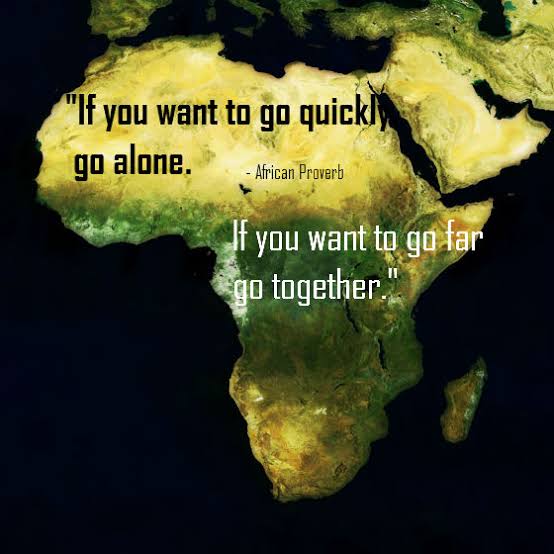
The future can be bright, but only if it is shared. The choice facing Africa is simple but profound. Either each country pulls alone and remains vulnerable, or the continent moves together and becomes unstoppable. History has already taught us what division brings. It is time to write a new story.
Africa’s destiny is collective. Its survival is collective. Its greatness is collective. Without unity, there is no future for Africa. But with unity, there is no limit to what this continent can achieve.