Historic G20 Summit in South Africa Signals a Turning Point for Africa’s Role in Global Governance
6 min read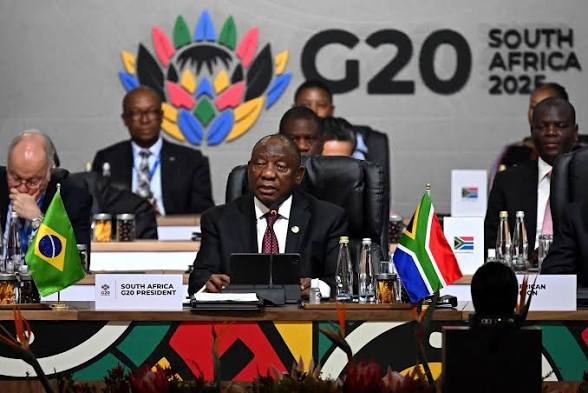
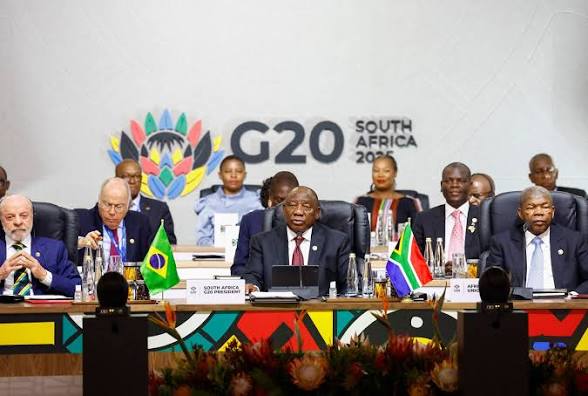
Johannesburg, South Africa — As leaders from the world’s 20 largest economies convened in Johannesburg for the first-ever G20 Leaders’ Summit on African soil, a profound shift in global economic narrative was unmistakable.
Under South Africa’s presidency, the summit was framed by the theme “Solidarity, Equality and Sustainability” — a message rooted in the African philosophy of Ubuntu, emphasizing mutual interdependence and shared responsibility.
For many in Africa, this summit represents more than diplomatic theater — it is a moment to assert agency. South African President Cyril Ramaphosa has long advocated for placing Africa’s development priorities at the heart of the global economic discourse and told parliament earlier this year that the G20 presidency was “a valuable opportunity … to place the needs of Africa … more firmly on the international development agenda.” 
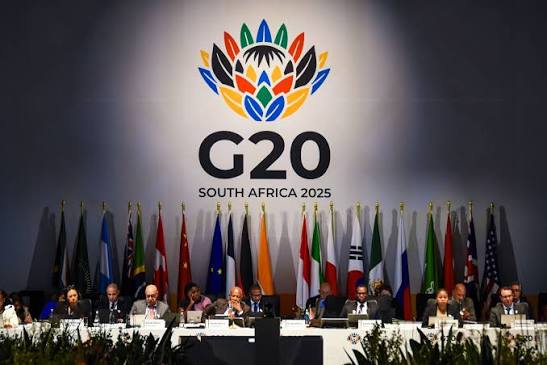
Indeed, African leaders meeting on the margins of the summit reaffirmed their alignment with the G20’s agenda, stressing the importance of private sector investment to unlock the continent’s economic potential.  They lauded the G20’s commitment to the African Union’s Agenda 2063, which articulates a long-term vision for inclusive growth, infrastructure, and regional integration across the continent.
One of the most consequential outcomes for Africa lies in the financial architecture reforms agreed during the summit. The G20’s Leaders’ Declaration recognizes the urgency of debt sustainability — a perennial barrier to development in many African countries. 
To that end, the summit launched the Africa Engagement Framework (AEF) for 2025–2030, intended to align global financial support with Africa’s economic priorities.
Crucially, the Compact with Africa (CwA) — an initiative first launched years ago — was reaffirmed in its second phase (2025–2033), backed by a new multi-donor World Bank fund.  The G20 also promised to strengthen debt treatment mechanisms under the Common Framework, reflecting recent challenges faced by nations such as Zambia, Ghana, Chad, and Ethiopia. 
Another headline decision: the G20 welcomed the creation of a new 25th chair on the IMF Executive Board, dedicated to enhancing Sub-Saharan Africa’s voice within the institution.  For many observers, this is a symbolic — and practical — nod toward more equitable representation in the architecture that governs global finance and loans.
Sustainable energy was also front and center. The G20 commitment to a “Mission 300” platform — with a goal of bringing electricity to 300 million people in Africa by 2030 — could reshape developmental trajectories for millions currently off-grid. The summit also welcomed a Voluntary Infrastructure Action Plan to scale up clean cooking solutions, recognizing the health and environmental toll of traditional cooking fuels.
In what many African observers called a step forward, the G20 endorsed an Ubuntu Legacy Initiative, aiming to strengthen cross-border infrastructure across the continent.  The aim is not just connectivity, but ownership — building infrastructure that serves Africa’s priorities, not just global profit flows.
And reflecting Africa’s urgency around climate change, the G20 reiterated its commitment to combating illicit financial flows (IFFs), a drain on resources that could otherwise fund green investments.  By aligning with the South African presidency’s earlier proposal to establish an “Ubuntu Commission” to study global public goods, the group signaled a willingness to probe deeper into how capital can be responsibly redistributed. 
Perhaps the most ambitious component of Africa’s G20 moment is the vision for industrial transformation. Despite its wealth of mineral reserves, fertile land, and human capital, the continent remains underindustrialized. South Africa’s G20 platform is calling for a reimagination — one that leverages exponential technologies (AI, advanced manufacturing, data science) to help build value-added economies. 
African voices at the summit pushed hard for a reinvigorated African Continental Free Trade Area (AfCFTA) as a catalyst.  By encouraging the manufacture and beneficiation of raw materials on the continent, the G20 signaled support for local industries rather than extract-and-export models. 
Equally significant was the spotlight on Africa’s creative economy — media, storytelling, and culture — as vehicles for soft power, identity, and growth. The G20 acknowledged that reshaping global perceptions of Africa will require Africans themselves to tell their own stories. 
In its declaration, the G20 welcomed a voluntary AI-for-Africa initiative — a multistakeholder partnership to build computing capacity, AI talent, and infrastructure across the continent.  This is not about passive aid; the goal is to foster sovereign AI ecosystems rooted in African contexts.
For ordinary Africans, the stakes are real. As analysts at Africanews note, this summit could translate into more stable incomes for young entrepreneurs, growth of digital businesses, and better access to remote education.  Furthermore, expanding digital access may unlock new pathways in farming, healthcare, and climate resilience for communities that have long been marginalized.
The business community also leaned in. Ahead of the summit, B20 South Africa, the business arm of the G20, delivered a set of 30 evidence-based policy recommendations to world leaders. These proposals span financing models, governance reforms, and measurable impact targets — signaling that private sector players are ready to be more than passive funders. As Cas Coovadia, B20 Sherpa, said: “This is Africa’s global moment … join us in leading change.” 
The G20’s development working group, meeting earlier in the year in Kruger National Park, adopted landmark declarations. These included calls for universal social protection, strengthened domestic resource mobilization, and aggressive action against illicit financial flows.  These outcomes, in turn, feed directly into African priorities of equity and inclusion.
But the summit is not without controversy. Civil society observers have pointed out that while lofty promises are being made, implementation is not automatic.
Debt-relief frameworks, built on voluntary cooperation, may not always deliver fast or deeply enough for the most vulnerable countries.
Others warn that without strong accountability measures, ambitious climate finance pledges may remain on paper.
Optimism is high across many corners of Africa. For some, the summit represents a rebalancing — a moment when global economic power is acknowledging that Africa’s future matters not just for the continent, but for the world.
The emphasis on innovation, sustainable industrialization, and human-centered growth is being seen as a pivot away from exploitative models of the past.
Yet there is no naïveté. African policymakers and activists alike are watching closely. The success of the summit’s promises will ultimately depend on follow-through: on real infrastructure investments, on debt treatments that don’t saddle nations with hidden strings, on clean-energy funding that reaches communities, and on digital transformation that doesn’t reinforce inequality.
As the G20 Summit closes in Johannesburg, several tangible legacies are emerging: a new financial architecture designed with African participation, a development agenda rooted in justice, more inclusive global governance structures, and a call to harness technology for public good. If realized, these could mark the summit as a turning point — not just for South Africa, but for the continent.
For many Africans, this moment is not merely symbolic. It is strategic. For the first time, in a forum traditionally dominated by major economies in the Global North, African priorities are being woven into the bedrock of global economic cooperation. And they are being done so in a language of dignity, innovation, and shared humanity.
About The Author