President Mnangagwa, Qatari Prime Minister Hold High-Level Talks
6 min read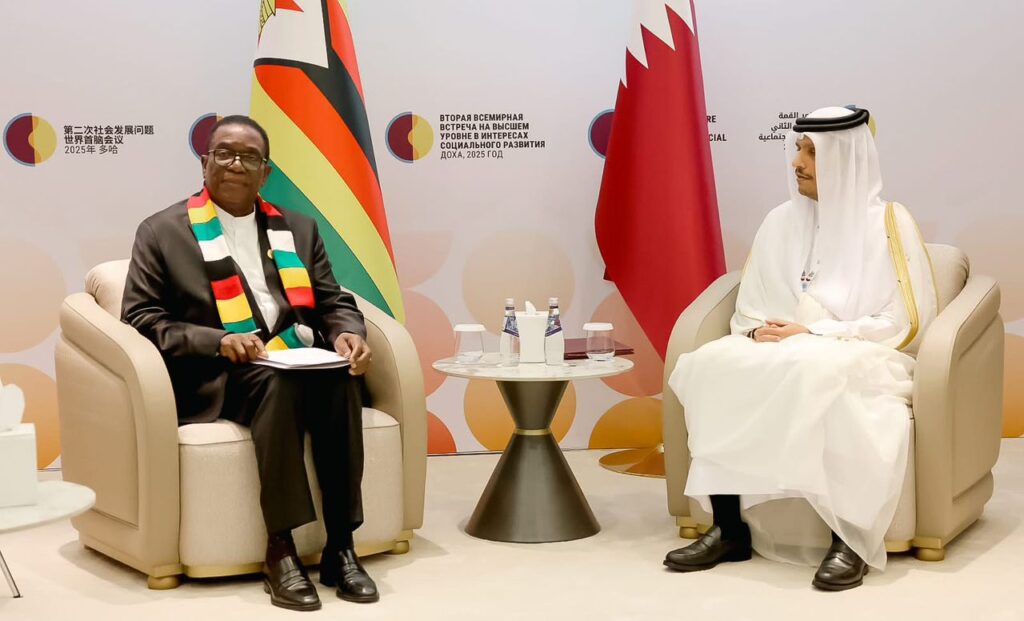
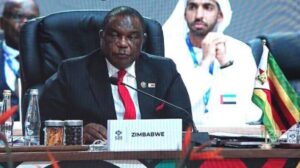
Doha, Qatar — In a significant diplomatic engagement aimed at deepening ties between Harare and Doha, the President of the Republic of Zimbabwe, His Excellency Dr. Emmerson Dambudzo Mnangagwa, today held a closed-door bilateral meeting with the Prime Minister and Minister of Foreign Affairs of the State of Qatar, His Excellency Sheikh Mohammed Bin Abdulrahman Al-Thani, on the sidelines of the Second World Summit on Social Development, currently underway in Doha.
The high-level meeting underscored Zimbabwe’s growing diplomatic outreach in the Gulf region and its commitment to fostering new alliances built on mutual respect, shared interests, and economic cooperation. The two leaders are said to have discussed a wide range of issues pertaining to bilateral relations, investment opportunities, and strategic cooperation in key sectors such as energy, agriculture, tourism, mining, and infrastructure development.
According to sources close to the Zimbabwean delegation, the meeting was marked by warmth and mutual understanding, with both leaders reaffirming their commitment to building a long-term partnership that aligns with the development aspirations of both nations.
The discussions between President Mnangagwa and Prime Minister Al-Thani come at a time when Zimbabwe is intensifying its “Engagement and Re-engagement Policy,” a foreign policy doctrine that seeks to strengthen ties with existing allies while forging new partnerships with nations across the world, particularly in Asia and the Middle East.
President Mnangagwa, who has championed the mantra “Zimbabwe is Open for Business,” has consistently emphasized the importance of attracting foreign investment as a cornerstone of Zimbabwe’s economic revival strategy. The President’s engagement with Qatar, one of the wealthiest and most strategically positioned nations in the Gulf, is widely viewed as part of this broader diplomatic and economic vision.
During the meeting, both leaders discussed ways to enhance trade relations, with a focus on diversifying economic cooperation beyond traditional sectors. Zimbabwe, which is rich in natural resources such as gold, platinum, lithium, and diamonds, presents numerous investment opportunities that could benefit from Qatar’s vast financial and technological capacities.
Likewise, Zimbabwe’s strong agricultural base offers a fertile ground for collaboration, particularly in the areas of food security and agricultural exports, where Qatar, being a largely desert nation, has shown keen interest in investing abroad to secure sustainable food supply chains.
The two leaders also explored potential partnerships in the energy sector, especially in renewable energy, gas, and petroleum development. Zimbabwe’s ongoing energy diversification drive—anchored on the expansion of solar and hydroelectric power generation—resonates with Qatar’s expertise in energy production and management.
Discussions are understood to have also touched on tourism and hospitality, sectors that both countries view as vital pillars of their respective economies. Zimbabwe, home to one of the Seven Natural Wonders of the World, Victoria Falls, seeks to attract Qatari investors into its burgeoning tourism and real estate markets. In turn, Qatar, which has successfully positioned itself as a global travel and sports hub, could provide valuable insights and investment to help modernize Zimbabwe’s tourism infrastructure.
Furthermore, the leaders deliberated on the importance of education, innovation, and technology transfer, areas that could enhance capacity building and skills development for Zimbabwean youth. President Mnangagwa reiterated his government’s vision of transforming Zimbabwe into a modern, industrialized, and knowledge-driven economy by 2030—an ambition that would benefit immensely from partnerships with technologically advanced nations such as Qatar.
The bilateral meeting took place within the broader context of the Second World Summit on Social Development, a gathering of world leaders, policymakers, and experts convened to discuss strategies for inclusive growth, poverty eradication, and sustainable development.
Both President Mnangagwa and Prime Minister Al-Thani expressed their shared commitment to promoting global social justice, human development, and the empowerment of marginalized communities. The discussions underscored the necessity of aligning bilateral cooperation with the goals of the United Nations’ Sustainable Development Agenda 2030, which emphasizes equitable access to education, healthcare, and employment opportunities.
Zimbabwe’s participation in the Summit reflects its ongoing efforts to reposition itself as an active player in the global development dialogue. President Mnangagwa has consistently advocated for fair and inclusive global economic systems that support developing nations in achieving sustainable growth without leaving anyone behind.
Qatar, one of the fastest-growing economies in the Middle East, wields significant influence in global energy markets and international diplomacy. As host of the summit, the country has positioned itself as a convener of international cooperation on issues of social and economic development.
For Zimbabwe, engaging with Qatar is of both economic and geopolitical importance. The Gulf state has been diversifying its investment portfolio worldwide, focusing on sectors such as real estate, agriculture, energy, and technology. Establishing stronger ties could open pathways for Zimbabwean exports, technology transfer, and access to financing for infrastructure projects.
Zimbabwe’s Foreign Affairs Ministry has indicated that efforts are already underway to finalize bilateral agreements that will formalize frameworks for cooperation between the two countries. These may include memoranda of understanding (MoUs) covering trade facilitation, investment protection, and tourism promotion.
The Doha meeting also builds on earlier diplomatic exchanges between Zimbabwe and Qatar. In recent years, officials from both governments have held preliminary talks exploring possible collaborations, particularly in the areas of energy and aviation. The latest high-level engagement at the summit represents a major step forward, signaling the political will on both sides to translate discussions into actionable projects.
Observers have hailed President Mnangagwa’s diplomatic outreach as timely and strategic. With global economies increasingly interconnected, Zimbabwe’s proactive engagement with emerging economic powers such as Qatar is seen as essential for stimulating investment inflows, creating jobs, and enhancing technological innovation at home.
Diplomatic analysts also point out that Zimbabwe stands to benefit from Qatar’s growing interest in Africa. Several African nations have already established successful trade and investment partnerships with Doha, and Zimbabwe’s entry into this circle of cooperation could significantly enhance its global economic footprint.
At the conclusion of the meeting, both leaders reaffirmed their mutual desire to strengthen the foundations of friendship and cooperation between Zimbabwe and Qatar. They agreed to pursue practical mechanisms to ensure that the discussions held in Doha are translated into tangible results that benefit the peoples of both nations.
President Mnangagwa expressed gratitude to His Excellency Sheikh Mohammed Bin Abdulrahman Al-Thani for Qatar’s continued engagement with Africa and for the hospitality extended to the Zimbabwean delegation during the summit.
He emphasized Zimbabwe’s readiness to work closely with Qatar in implementing collaborative projects that align with national priorities such as industrialization, energy security, and human capital development.
Today’s bilateral meeting between President Mnangagwa and Prime Minister Al-Thani marks a new chapter in Zimbabwe-Qatar relations—one defined by shared vision, economic cooperation, and global solidarity. As the world continues to grapple with social and economic inequalities, such partnerships demonstrate the power of diplomacy to bridge divides and foster collective progress.
For Zimbabwe, this engagement not only strengthens its ties with one of the most influential nations in the Middle East but also reinforces its message to the world: that Zimbabwe is indeed open for business and ready to play its part in shaping a more inclusive and prosperous global community.
About The Author