

VICTORIA FALLS, Zimbabwe: Zimbabwe has placed solar energy and Africa’s wider energy transition firmly at the centre of continental development discussions as the country hosts the 8th Meeting of the International Solar Alliance Regional Committee for Africa in the resort city of Victoria Falls.
The high level gathering, running from 25 to 27 August, has brought together African governments, development partners, technical institutions, industry representatives and other stakeholders to accelerate solar deployment, strengthen energy access and explore new opportunities for investment across the continent. More than 40 African countries are represented at the meeting, according to reports from the opening proceedings.
President Emmerson Mnangagwa is expected to officially open the meeting virtually from Harare, with the summit placing Zimbabwe at the centre of discussions about how Africa can use its abundant solar resources to address energy shortages, support agriculture, stimulate industrialisation and create new opportunities for young people.
The International Solar Alliance has described the Victoria Falls meeting as a significant milestone because it brings the African regional committee to Southern Africa for the first time. The organisation has said the gathering is intended to help African countries jointly set priorities, mobilise partnerships and develop solutions that reflect the continent’s own realities and aspirations.
Zimbabwe Champions Africa’s Solar Potential
In remarks delivered during the engagement, Zimbabwe emphasised the enormous potential represented by the continent’s natural solar resources.
The country argued that Africa’s sunlight should not simply be viewed as an environmental resource or an alternative source of electricity. Instead, solar power must become a strategic instrument for industrialisation, modernisation, economic transformation and improved access to essential services.
That vision places renewable energy within the broader framework of Africa’s development ambitions, particularly the African Union Agenda 2063, which seeks to build a prosperous, integrated and sustainable continent.
For Zimbabwe, the argument is particularly important as the country continues working to strengthen electricity generation, expand access and support economic activity.
The Government has been pursuing greater diversification of the energy mix, with solar and other renewable sources expected to play an increasingly important role in meeting future electricity demand.
Recent national development discussions have similarly identified energy security as an important foundation for industrial and economic growth. Zim Global Media previously reported on the Government’s wider energy and infrastructure priorities in its coverage of the national development agenda. 2025 SONA Speaks to National Growth, Resilience and Purpose
From Solar Potential to Industrial Power
The message emerging from Victoria Falls is that Africa can no longer afford to treat solar energy as a peripheral solution.
The continent possesses some of the world’s richest solar resources, yet millions of people remain without reliable access to electricity.
The challenge, therefore, is increasingly about turning natural potential into functioning infrastructure, productive industries and affordable energy for communities.
This requires significant investment in solar generation, transmission networks, battery storage, mini grids and related technologies.
It also requires African countries to work together.
Zimbabwe has called for greater leverage around regional and continental financing platforms while encouraging the expansion of regional electricity markets and shared infrastructure.
Such cooperation could help countries overcome one of the biggest obstacles facing renewable energy development: the high cost of financing large infrastructure projects.
The International Solar Alliance has been advancing initiatives designed to mobilise financing, technical assistance and investment for solar projects across developing countries. Its Africa agenda includes efforts to operationalise the Africa Solar Facility, strengthen project preparation and improve access to capital.
The meeting in Victoria Falls therefore comes at a critical moment as African governments seek practical ways of moving from ambitious energy commitments to projects that can deliver electricity to households, businesses, farms and public institutions.
Solar Energy and Agriculture
One of the strongest themes emerging from the Zimbabwean discussions is the potential of solar energy to transform agriculture.
Reliable electricity is essential for irrigation, cold storage, food processing and other agricultural activities.
Solar powered irrigation can allow farmers to reduce dependence on diesel powered pumps while extending production into periods when rainfall is limited.
For Zimbabwe, where agriculture remains closely linked to food security, rural livelihoods and industrial development, the opportunity is significant.
The Victoria Falls meeting is expected to advance the use of solar energy in agriculture, with reports indicating that the Zimbabwe Declaration will prioritise solar applications within the agricultural sector. Zimbabwe is also expected to become the 11th African country to sign the Africa Solar Facility.
Such developments could create opportunities for farmers, agribusinesses, technology companies and financial institutions to participate in a growing renewable energy ecosystem.
Women and Youth Must Be at the Centre
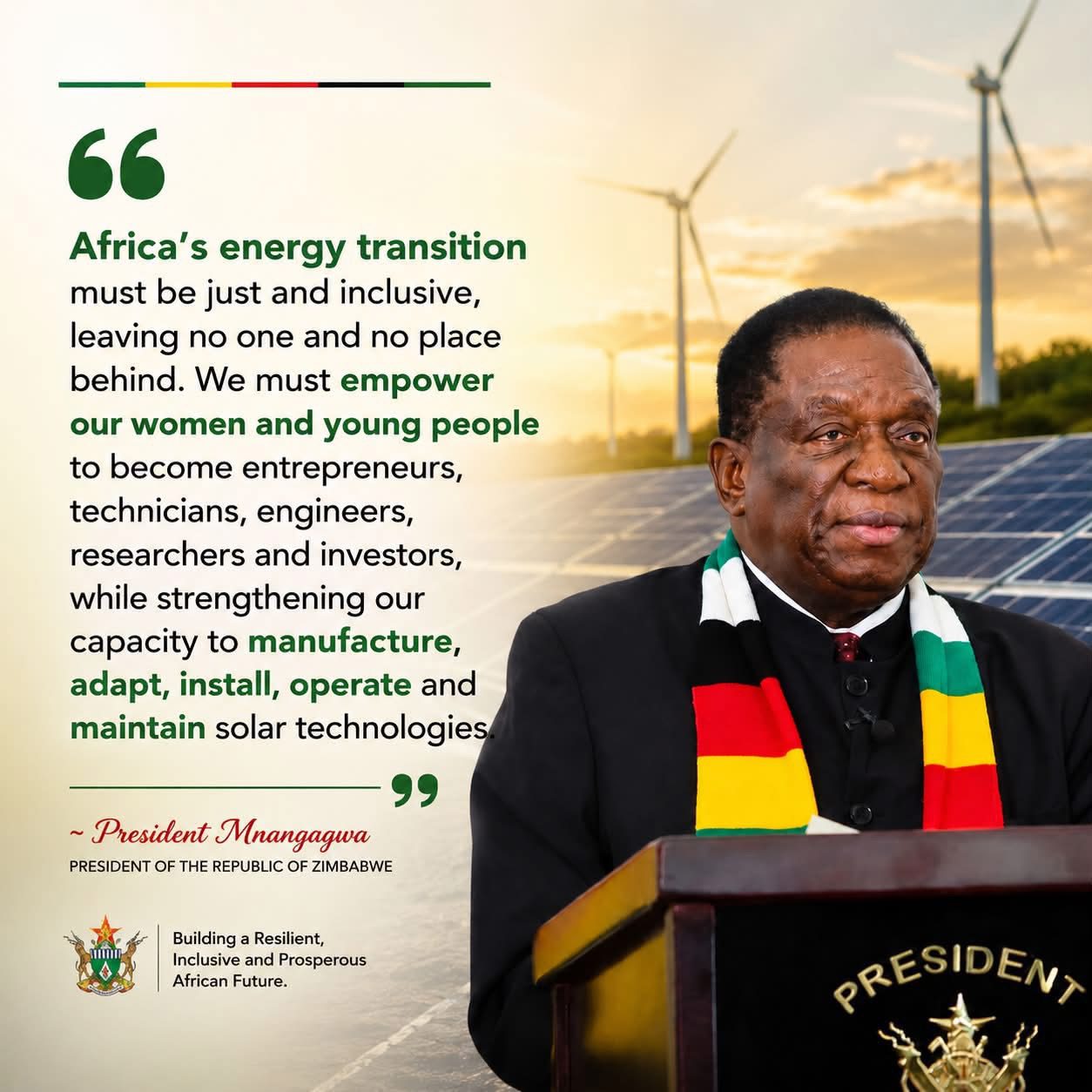
Zimbabwe has also stressed that Africa’s energy transition must be inclusive.
The move towards renewable energy cannot simply mean importing equipment and installing solar panels.
African countries need to build their own technical capabilities so that local people can manufacture, adapt, install, repair and maintain solar technologies.
Women and young people must be central participants in this transformation.
They can become entrepreneurs supplying solar equipment, technicians maintaining installations, engineers designing systems, researchers developing new applications and investors building renewable energy businesses.
This approach could transform the energy transition into a major employment and skills development opportunity.
The Solar Technology Application Resource Centre, commonly known as STAR-C, is one initiative designed to support this objective through technical knowledge, training and skills development.
The International Solar Alliance has been supporting STAR-Centres and wider capacity building programmes across Africa, with thousands of professionals already benefiting from solar related training initiatives.
For Zimbabwe, strengthening such programmes could help create a generation of skilled young people capable of participating meaningfully in the country’s emerging renewable energy economy.
A Just and Inclusive Energy Transition
Zimbabwe’s position also carries a broader message about the nature of Africa’s energy transition.
The transition must be just, inclusive and designed to ensure that no community is left behind.
For many rural communities, electricity is not simply a convenience. It can determine whether a clinic can provide essential services, whether a school can access digital learning resources, whether farmers can irrigate crops and whether small businesses can operate after sunset.
Solar power therefore has the potential to change everyday life far beyond the electricity sector.
The International Solar Alliance has highlighted similar practical applications through demonstration projects across Africa, including solar solutions supporting healthcare, water access, agriculture and local enterprise.
This practical approach is important because Africa’s energy transition will ultimately be judged not only by the amount of solar capacity installed, but by the lives improved through that investment.
Victoria Falls Provides a Powerful African Setting
The choice of Victoria Falls as the host city also carries considerable symbolic and economic importance.
Known locally as Mosi-oa-Tunya, meaning “The Smoke That Thunders”, the destination is one of Zimbabwe’s most important tourism assets and one of Africa’s most recognisable natural landmarks.
Hosting an international energy summit in the city allows Zimbabwe to showcase both its tourism potential and its growing role in continental development conversations.
Zim Global Media recently explored the continuing global appeal of Victoria Falls, highlighting the destination’s importance to tourism, hospitality and Zimbabwe’s wider economic ambitions. Victoria Falls – Africa’s Greatest Natural Wonder Continues to Captivate Global Tourists
The gathering also reinforces the growing connection between tourism, infrastructure, energy and investment.
A modern tourism destination requires reliable electricity, efficient transport, digital connectivity and sustainable infrastructure. Renewable energy can increasingly become part of that equation.
Africa’s Solar Moment
The Victoria Falls meeting arrives with a clear message: Africa’s solar opportunity must be converted into action.
The continent cannot rely indefinitely on external solutions while possessing enormous renewable energy potential of its own.
African countries need stronger regional cooperation, innovative financing, technical skills, local manufacturing capacity and policies capable of attracting responsible investment.
Zimbabwe’s participation in the International Solar Alliance provides an opportunity to position the country within that wider transformation.
The challenge now is to ensure that discussions produce tangible outcomes.
Solar projects must move from conference rooms into communities. Financing commitments must become infrastructure. Training programmes must become jobs. Technology partnerships must produce local expertise. And renewable energy must ultimately translate into better healthcare, stronger agriculture, productive industries and improved livelihoods.
The Victoria Falls meeting provides an important platform for that conversation.
As Zimbabwe welcomes partners from across Africa and beyond, its central message is one of opportunity.
Africa has the sunlight.
Africa has the people.
Africa has the need.
What remains is to build the partnerships, financing systems, technical capacity and political commitment required to turn that potential into lasting prosperity.
For Zimbabwe and the continent as a whole, the International Solar Alliance offers a framework through which the power of the sun can become more than a source of electricity.
It can become a foundation for industrialisation, inclusion, innovation and a more secure African future.