

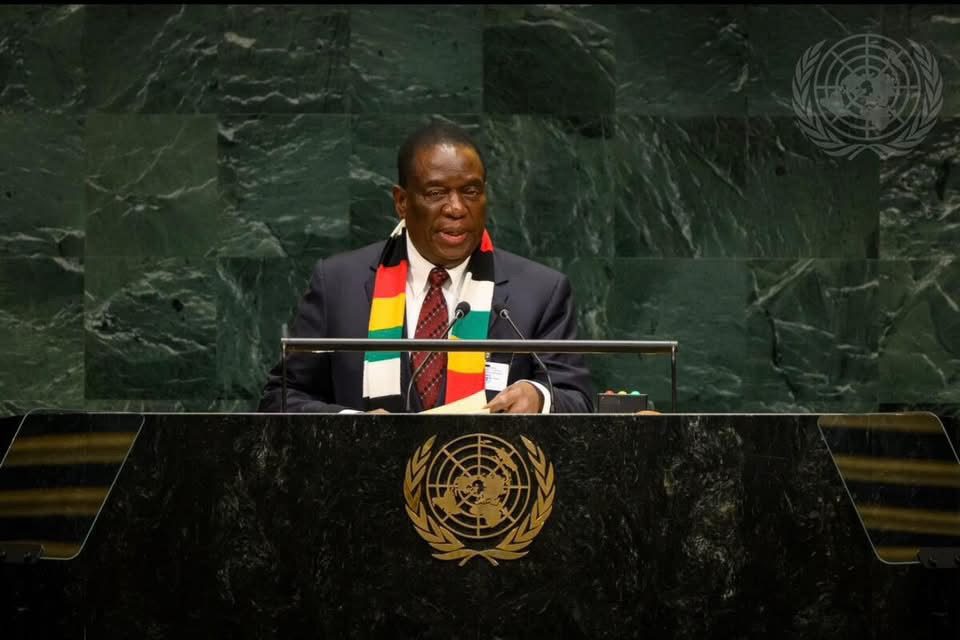
NEW YORK — President Emmerson D. Mnangagwa has called for stronger international cooperation, consistent application of international law and comprehensive reform of global governance institutions as Zimbabwe prepares to take up its seat on the United Nations Security Council for the 2027–2028 term.
Addressing the 81st Session of the United Nations General Assembly under the theme “Restoring Trust, Managing Transformation,” President Mnangagwa said the international community was meeting at a critical moment marked by armed conflicts, climate-related challenges and rapid technological transformation.
He congratulated His Excellency Dr Rahman on his election as President of the 81st Session of the General Assembly and expressed Zimbabwe’s support for his leadership.
President Mnangagwa also paid tribute to Annalena Baerbock for her stewardship of the 80th Session and acknowledged United Nations Secretary-General António Guterres during what he described as his final General Debate as Secretary-General.
He said the challenges facing humanity increasingly transcend national borders and require collective responses.
“No nation can overcome them alone,” President Mnangagwa said, stressing the importance of restoring confidence in multilateral institutions.
He called for international law to be applied universally and consistently, arguing that it should not be selectively applied to different countries.
Zimbabwe prepares for Security Council role
Zimbabwe is set to assume its seat on the United Nations Security Council for the 2027–2028 term in January.
President Mnangagwa said Zimbabwe would approach its responsibilities with humility, independence and a commitment to serving the broader international community.
He said Zimbabwe’s foreign policy principle of being “a friend to all and an enemy to none” would continue to guide its international engagement.
Among the priorities outlined are the promotion of preventive diplomacy and peaceful dispute resolution, stronger cooperation between the United Nations and regional organisations such as the African Union, and efforts to address terrorism, organised crime and illegal resource trafficking.
The President also stressed the importance of ensuring that women and young people have an active role in shaping the global peace and security agenda.
Call for Security Council reform
President Mnangagwa renewed Zimbabwe’s call for reform of the United Nations Security Council, arguing that its current structure should better reflect contemporary geopolitical realities.
He said Africa should have a greater voice in global decision-making and described the continent as “united, sovereign, independent and rising.”
He also called for the removal of unilateral coercive measures, arguing that the international community should pursue greater solidarity and shared prosperity.
Development and global financing
President Mnangagwa linked international peace and security to economic development, noting the limited time remaining to achieve the 2030 Agenda for Sustainable Development.
He said developing countries continue to face substantial financing challenges and called for reforms to global financial institutions to address Africa’s borrowing costs and risk premiums.
According to the President, addressing these structural financing challenges is essential if developing countries are to accelerate investment and achieve sustainable development.
Zimbabwe’s domestic development agenda
Turning to Zimbabwe’s domestic development programme, President Mnangagwa said the country was continuing to pursue economic growth through macroeconomic policies, food-security initiatives, climate-smart agriculture and rural industrialisation.
He said Zimbabwe was “open for business” and highlighted efforts to direct investment towards rural infrastructure while empowering women and young people.
The President said the Government remained committed to ensuring that development reaches communities across the country.
He concluded by calling on the international community to protect the principles of the United Nations Charter, reject selective compliance and work towards a more inclusive international system for future generations.