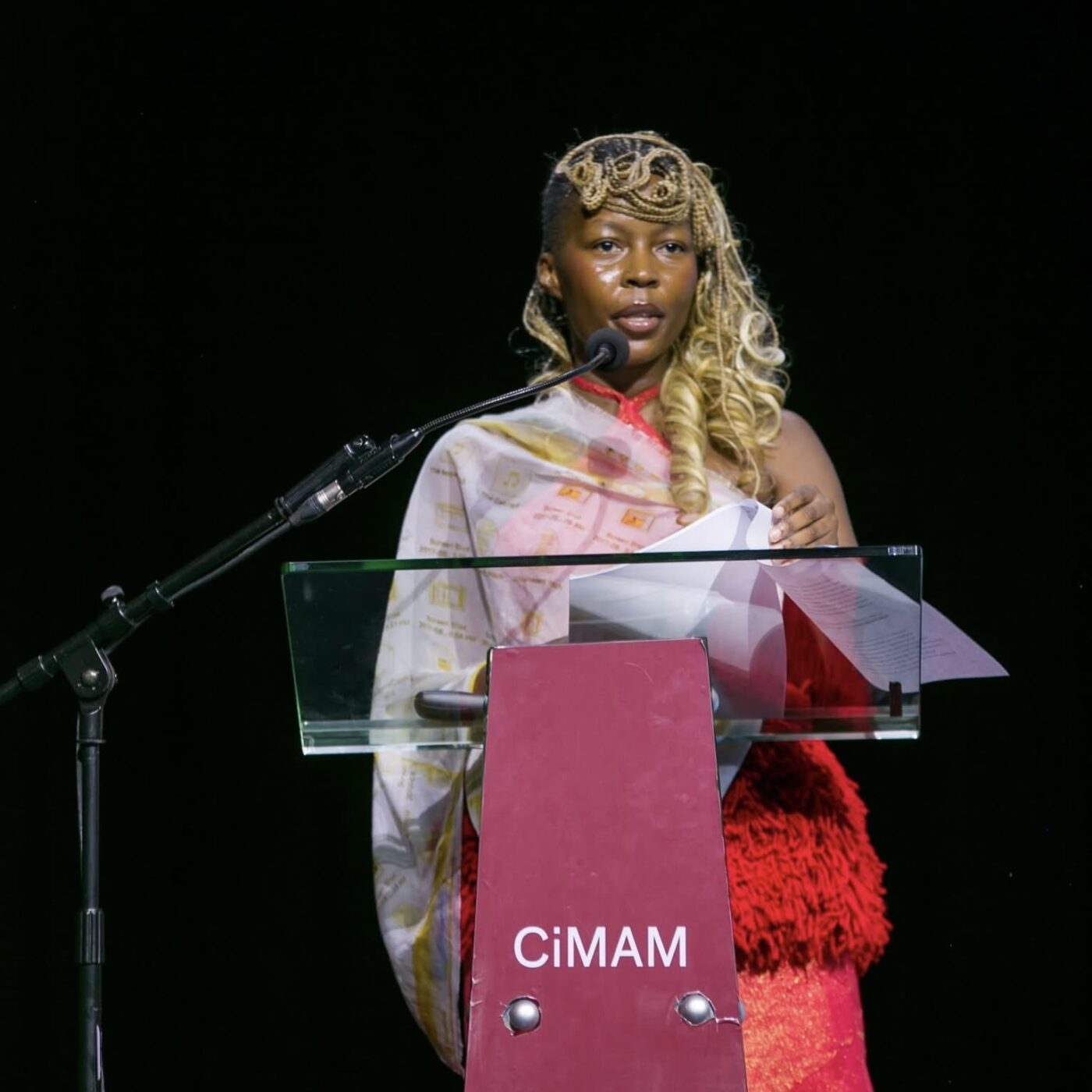
HARARE, Zimbabwe – Neema Githere’s CIMAM 2026 presentation brought an intellectually provocative African perspective to the international contemporary art and museum community, challenging conventional understandings of technology, human identity, Indigenous knowledge systems and the relationship between humanity and the natural environment.
The writer, artist and relational architect from Studio Nkisi, Nairobi, Kenya, presented a compelling session titled “Afropresentism.OS: Embodied Eco Logics and Sourealism” during the 58th Annual Conference of the International Committee for Museums and Collections of Modern Art (CIMAM), taking place in Harare from November 20 to 22, 2026.
Her presentation introduced an experimental conceptual framework exploring how African and pan-Indigenous ways of knowing can contribute to contemporary conversations about technology, ecological relationships, cultural memory and the future of human existence.
At its centre was Afropresentism.OS, which Githere described as a jazz-techne and pan-Indigenous intervention designed to re-pace, rather than replace, the cultural impulses that most fundamentally define humanity.
The distinction between re-pacing and replacing provides an important foundation for understanding her argument. Rather than suggesting that technological advancement should erase existing cultural practices, the presentation encourages a reconsideration of how societies engage with innovation while maintaining the knowledge systems, relationships and lived experiences that give human existence meaning.
In an increasingly digital world, where artificial intelligence, algorithmic systems and interconnected technologies are transforming how people communicate, create and understand themselves, Githere’s work raises important questions about what humanity risks losing when technological progress becomes disconnected from cultural and ecological realities.
Her intervention also challenges the assumption that the future must necessarily be built by abandoning the wisdom of the past.
Through Afropresentism.OS, she explores the possibility of bringing Indigenous knowledge, contemporary technology and creative expression into a more meaningful relationship.
The presentation is particularly relevant at a time when artificial intelligence is becoming increasingly influential in the production, circulation and interpretation of knowledge.
Githere’s work invites audiences to consider the origins of digital information, the communities whose knowledge contributes to technological development and the ecological consequences of the infrastructure supporting the digital world.
Behind seemingly invisible digital interactions are physical systems involving fibre-optic networks, data centres, energy consumption and natural resources. The digital environment is therefore not detached from the physical world. It remains deeply connected to land, water, energy and the communities that sustain these systems.
By bringing these relationships into the discussion, Githere expands the meaning of ecological thinking beyond conventional environmental concerns.
Her approach suggests that ecological relationships should also inform how humanity develops technology, organises knowledge and maintains connections across different communities and generations.
A particularly interesting dimension of the presentation was the introduction of Sourealism, a concept Githere positions within the broader Afropresentism framework.
Drawing phonically on Surrealism, Sourealism introduces a different way of thinking about reality, identity and human presence in an increasingly automated world.
The expression also draws attention to the urgency of affirming one’s reality in a technological environment where individuals are frequently required to prove that they are human through digital verification systems.
The phrase carries a deeper philosophical question: what does it mean to be human in a world where machines increasingly mediate everyday experiences?
As people interact with automated systems, artificial intelligence platforms and digital identities, questions of authenticity, belonging and human agency become increasingly important.
Githere’s conceptual intervention challenges audiences to look beyond the convenience of technology and consider the cultural and emotional dimensions of human existence.
The presentation also explored the significance of language and its relationship with technology through the Portuguese word rede, which can mean both a hammock and the internet in Brazilian Portuguese.
This linguistic connection provides an intriguing point of departure for considering how technology might be understood differently.
A hammock represents rest, support, connection and a place of belonging. The internet, meanwhile, represents interconnected networks through which information, relationships and experiences travel across geographical boundaries.
By placing these two meanings alongside each other, Githere invites audiences to imagine technological networks not simply as instruments of communication and information exchange, but as spaces capable of supporting relationships, collective memory and human connection.
This perspective challenges the dominant understanding of digital infrastructure as something purely mechanical or transactional.
It creates room for a more relational understanding of technology, one that recognises the importance of care, community, memory and shared experiences.
Her presentation also raises questions about how the internet has evolved into what she describes as a turbulent yet consequential floating homeland.
For millions of people across the world, digital platforms have become important spaces for maintaining cultural identity, preserving connections with ancestral communities and negotiating experiences of migration, displacement and belonging.
This is particularly significant for African communities and the wider diaspora, whose cultural identities frequently extend across national borders.
Digital spaces provide opportunities to share languages, music, artistic expressions, historical knowledge and cultural practices that might otherwise remain geographically separated.
However, these spaces also operate within technological systems that are not always designed around the priorities, histories and cultural realities of African communities.
Githere’s work therefore encourages a reconsideration of how Indigenous knowledge and cultural identity can be protected, represented and meaningfully integrated into digital environments.
Her practice at Studio Nkisi explores these questions through relational architecture, participatory artistic processes and what she describes as Afropresentism and Data Healing.
Data Healing emerged in 2019 as a conceptual ecosystem committed to exploring Indigenous ecological thinking as an alternative response to the consequences of digital systems and algorithmic displacement.
The approach introduces the possibility of understanding data not merely as information to be collected, processed and commercialised, but as something connected to people, relationships, histories and collective experiences.
This perspective offers an important contribution to contemporary debates about digital ethics, cultural ownership and the representation of communities within technological environments.
It also reinforces the importance of African intellectual contributions in shaping discussions about the future of technology and contemporary culture.
Githere’s participation at CIMAM 2026 is particularly significant because it demonstrates the expanding scope of contemporary art discourse.
Art is no longer confined to the traditional boundaries of painting, sculpture and exhibition spaces. Increasingly, artistic practice engages with questions of technology, identity, ecological sustainability, social relationships and the politics of knowledge.
Her presentation illustrates how contemporary artists and cultural thinkers can use creative practice to interrogate complex global developments while drawing inspiration from African and Indigenous intellectual traditions.
It also reflects the broader ambition of CIMAM 2026, which brings together international museum leaders, curators, researchers, artists and cultural practitioners to reconsider the responsibilities and possibilities of museums in a changing world.
The conference is being held under the theme “Museums Beyond Limits: Imagining Repair Across Cultures, Ecologies and Knowledges.”
Githere’s presentation speaks directly to this theme by exploring the connections between cultural knowledge, ecological relationships and technological transformation.
The idea of repair is particularly relevant to societies navigating the consequences of historical displacement, environmental degradation, cultural exclusion and technological disruption.
For African museums, these conversations create opportunities to rethink how collections are interpreted, whose knowledge is recognised and how cultural institutions can become more responsive to the communities they serve.
Zimbabwe’s hosting of the conference provides an important platform for these conversations to take place within an African cultural environment.
The country has a rich artistic heritage, a long history of Indigenous knowledge systems and a contemporary creative sector that continues to contribute to international artistic expression.
Through the National Gallery of Zimbabwe and other cultural institutions, the country is participating in a broader international conversation about the relationship between artistic heritage, modernity and the future of cultural institutions.
The importance of this engagement has been explored in Zim Global Media’s earlier coverage, Africa Moves from Exhibition to Authority as Zimbabwe Hosts CIMAM 2026, which examines the significance of Africa taking a more influential position in international cultural conversations.
Similarly, CIMAM 2026: Harare Prepares for Three Days of Transformative Global Museum Conversations, explores the conference’s wider programme and its three interconnected themes of Good Museum Practice, Tools of Transformation and Radical Hospitality.
Githere’s intervention adds another important dimension to these discussions by placing African and pan-Indigenous intellectual traditions at the centre of debates about technological futures.
Her work reminds audiences that innovation does not have to mean cultural erasure. Technology can evolve alongside traditional knowledge, collective memory and the relationships that connect people to their communities and environments.
For Zimbabwe and the wider African continent, this is an important consideration as governments, educational institutions, museums and creative industries increasingly embrace digital transformation.
The challenge is to ensure that technological advancement remains connected to cultural identity, human dignity and ecological responsibility.
African societies have an opportunity to contribute more than artistic objects and cultural exhibitions to international conversations. They can also contribute intellectual frameworks, philosophical approaches and alternative ways of understanding the relationship between humanity, technology and nature.
Through Afropresentism.OS, Neema Githere invites the international arts community to reconsider the pace and direction of technological change while recognising the enduring importance of Indigenous knowledge.
Her presentation ultimately raises a question that extends far beyond the walls of a museum: as humanity builds increasingly sophisticated technological systems, how can it ensure that the very qualities that make people human are not lost in the process?
It is a question that places African knowledge systems, cultural memory and ecological consciousness firmly within the conversation about humanity’s future.
As CIMAM 2026 continues in Harare, contributions such as Githere’s demonstrate the intellectual richness of the international gathering and reinforce the importance of creating spaces where different cultures, disciplines and knowledge systems can engage on equal terms.
For Africa, the opportunity is not simply to participate in defining the future of contemporary art, but to help shape the ideas, values and intellectual foundations upon which that future will be built.