
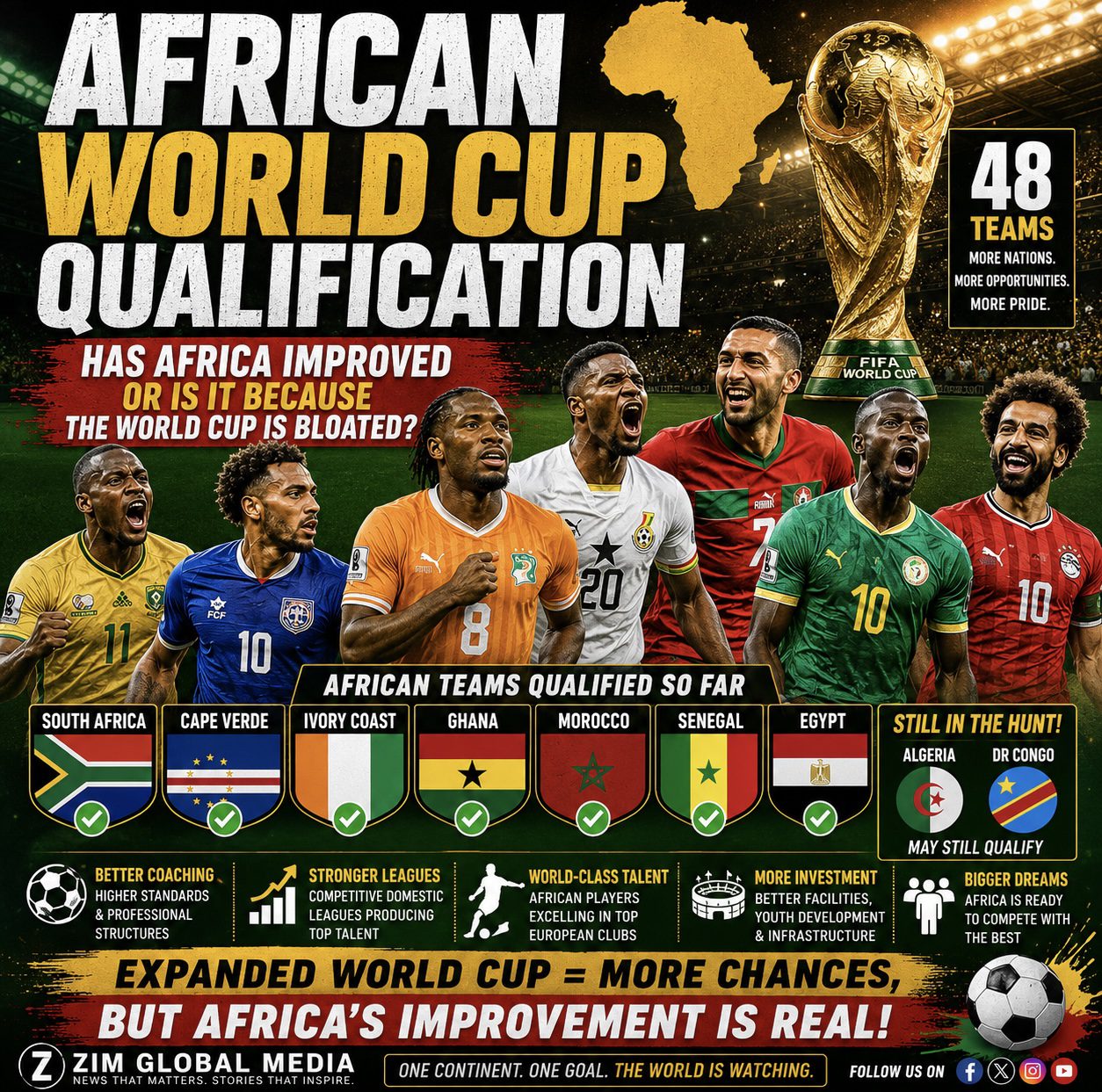
Sports Buzz – African World Cup Qualification has become one of the biggest talking points in global football following the impressive performances by African nations at the FIFA World Cup qualifiers. With seven countries already securing qualification and more potentially joining them, football enthusiasts across the continent are debating whether Africa has genuinely improved or if the expansion of the FIFA World Cup has simply made qualification easier.
South Africa, Cape Verde, Ivory Coast, Ghana, Morocco, Senegal and Egypt have already booked their places at football’s biggest tournament. Algeria and the Democratic Republic of Congo also remain in strong contention to qualify, potentially increasing Africa’s representation even further.
The debate has sparked excitement among supporters, analysts and former players alike, with opinions divided over whether this marks a new era for African football or reflects the opportunities created by FIFA’s decision to increase the number of participating nations.
Expanded World Cup Creates More Opportunities
One undeniable factor is FIFA’s decision to expand the FIFA World Cup from 32 teams to 48 teams beginning with the next tournament.
Under the previous format, Africa was allocated only five guaranteed places despite boasting 54 FIFA member associations. Many football observers argued that the continent was consistently underrepresented considering its enormous talent pool.
The expanded tournament has increased Africa’s guaranteed slots significantly, giving more nations realistic opportunities to qualify. This has reduced the brutal competition that previously saw several top African sides eliminated despite strong qualifying campaigns.
Countries that narrowly missed qualification in previous editions now have a genuine pathway to football’s grandest stage.
Africa’s Football Standards Continue Rising
While the expanded tournament has certainly helped, it would be inaccurate to dismiss the remarkable progress African football has made over the past decade.
African players now feature prominently in Europe’s biggest leagues, competing weekly in the English Premier League, La Liga, Serie A, Bundesliga and Ligue 1. Their experience at elite clubs has strengthened national teams considerably.
Morocco’s historic run to the FIFA World Cup semi-finals in Qatar demonstrated that African teams are capable of competing with football’s traditional powerhouses.
Similarly, Senegal won the Africa Cup of Nations and continues to maintain consistency at the highest level, while Ivory Coast recently showcased its resilience by winning the continental championship on home soil.
South Africa has also experienced renewed growth following improved youth development structures and greater investment in domestic football.
Better Coaching and Professional Structures
Another important contributor has been the appointment of experienced technical teams.
Many African football federations have invested heavily in qualified coaches, sports scientists, video analysts and modern training facilities.
Professional administration has gradually improved in several countries, allowing national teams to prepare better for major competitions.
Football academies across North, West and Southern Africa continue producing technically gifted players who transition smoothly into professional football.
The gap between African nations has also narrowed considerably, making continental competitions more competitive than ever before.
Homegrown Talent Flourishing
Unlike previous generations that relied almost entirely on Europe-based stars, several African countries now boast competitive domestic leagues capable of producing national team players.
The South African Premier Division, Morocco’s Botola Pro League and Egypt’s Premier League continue supplying talent to national teams while also exporting players to Europe and the Middle East.
This growing football ecosystem has strengthened squad depth across the continent.
South Africa’s Return Signals Progress
South Africa’s qualification represents an important milestone after years of inconsistency.
Bafana Bafana have steadily rebuilt under improved technical leadership, blending experienced internationals with exciting young talent.
Their qualification reflects years of rebuilding rather than mere good fortune.
The country’s domestic league remains among Africa’s strongest financially and competitively, providing a solid platform for player development.
Cape Verde Continues Defying Expectations
Perhaps one of the biggest success stories is Cape Verde.
Despite its relatively small population, the island nation continues punching above its weight in African football.
Disciplined organisation, tactical discipline and effective scouting of players within its diaspora have enabled Cape Verde to compete consistently against larger footballing nations.
Their qualification demonstrates that strategic planning can overcome limitations in population size and financial resources.
Morocco Setting New Standards
Morocco’s achievements over recent years have raised expectations for African football.
Its World Cup semi-final appearance inspired confidence throughout the continent, proving that African teams can challenge football’s elite when supported by proper infrastructure, coaching and long-term planning.
Morocco has heavily invested in football academies, sports science and youth development over many years.
Other African nations are now adopting similar models.
Is the World Cup Expansion Enough?
While the expanded tournament undeniably offers more qualification places, earning a World Cup ticket remains far from easy.
African qualifying campaigns continue to involve highly competitive group matches, long-distance travel and difficult away fixtures.
Countries still need consistency, tactical discipline and quality squads to qualify.
Simply increasing available slots does not automatically guarantee success.
Rather, it rewards nations that have invested wisely in football development.
The Verdict
The reality is that both arguments contain elements of truth.
Yes, the expanded FIFA World Cup has provided Africa with fairer representation and more qualification opportunities.
However, Africa’s football has also improved significantly.
Better coaching, increased investment, stronger domestic leagues, improved youth development and greater international experience have all contributed to the continent’s rise.
The performances witnessed over recent years suggest African football is no longer merely participating in global tournaments—it is increasingly competing to win.
If Algeria and the Democratic Republic of Congo also qualify, Africa could send one of its strongest collections of teams to a FIFA World Cup in history.
The continent now possesses both the talent and the belief to challenge football’s established powers.
As the World Cup approaches, the question may no longer be whether Africa deserves more places. Instead, it could become how many African nations are capable of reaching the latter stages of the tournament.
One thing is certain: African football has entered an exciting new chapter, and the world will be watching.
The expanded FIFA World Cup has undoubtedly opened more doors for African nations, but those doors are being walked through by teams that have genuinely improved. Investment in coaching, player development, infrastructure and professional administration has transformed many African football associations. Rather than viewing qualification as a product of expansion alone, it should also be recognised as evidence of the continent’s growing football maturity. The next World Cup will provide Africa with another opportunity to prove that its rise is real and sustainable.
Read More: