

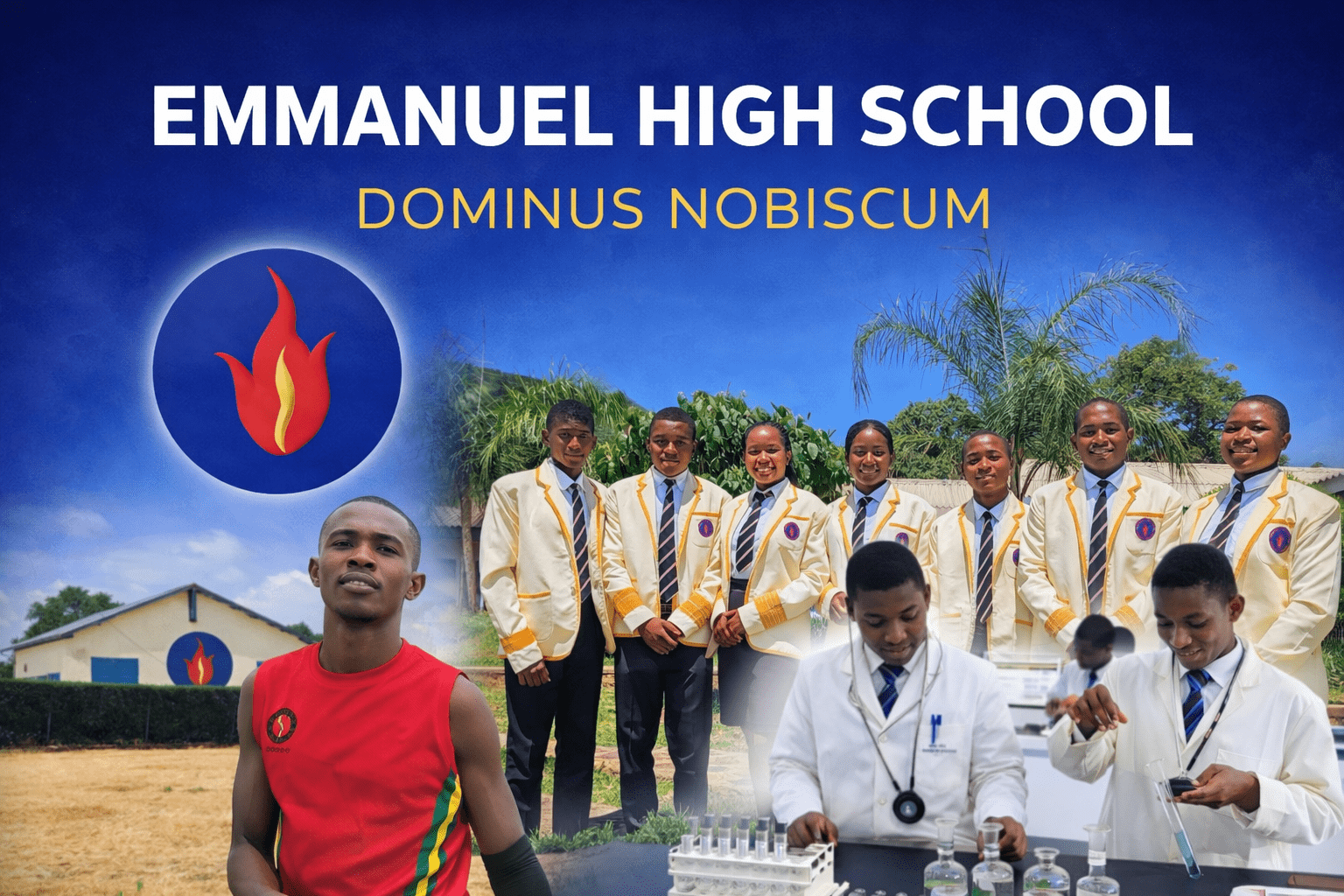
The Columnist – Emmanuel High School stands as one of Zimbabwe’s most quietly influential schools. Known to generations of families simply as Emmanuel, the institution has grown from a humble church mission dream into a respected educational institution that continues to shape young minds more than six decades after its founding idea first took root.
Long before the school opened its gates, the Elim Pentecostal Church had already planted its presence in North Nyanga. The year was the early 1950s, and Zimbabwe was still Southern Rhodesia.

At a time when access to education and healthcare for rural African communities was scarce, a husband and wife medical team, Dr. Cecil and Mary Brien, set foot in Katerere.
They came as part of the Elim Pentecostal Mission, carrying not only medicine and nursing knowledge, but also a vision to uplift the people they lived among.
What began as a mission hospital soon inspired a much broader calling. Each patient treated and each family visited pointed to the same lesson: children needed schools close to home, and parents yearned for opportunity.
Education was a doorway to literacy, economic participation and dignity, and the Elim missionaries believed deeply that the Christian message should be inseparable from practical service.
The church began supporting primary schooling where it could, laying the groundwork for a secondary school that did not yet exist.
For years, the idea lived more in prayer and planning circles than in bricks and mortar. It took courage, persistence and negotiation to win recognition from authorities.
Those closest to the dream worked through setbacks and long delays, but by 1964, their efforts finally bore fruit.
Permission was granted for the establishment of a fully fledged secondary school. It was a turning point that transformed aspiration into action.

Once approval came, there was no time wasted. In 1964 a young church worker, Alan Renshaw, took responsibility for planning and supervising construction.
The task was monumental for a mission team with modest resources. Classrooms had to be designed, materials sourced and delivered to remote Nyanga, and staff houses erected to accommodate teachers who would have to relocate. But where funds or experience fell short, determination filled the gaps. Villagers assisted. Mission workers carried tools. Timber arrived in carts and lorries that laboured along winding roads.
By 1965, the foundations of the future Emmanuel High School had taken shape. The name chosen for the institution was not simply poetic or symbolic. Emmanuel means “God with us”, and at every step in the early story of the school the founders believed they saw providence at work.
Naming the school after that divine assurance was both declaration and commitment. Children would learn mathematics and geography, yes, but they would also be nurtured in Christian values that shaped character, responsibility and purpose.
A school is not just buildings, and Emmanuel’s first breath of life came when its inaugural headmaster stepped forward.
Peter Griffiths, a man remembered for his leadership and steadiness, became Emmanuel’s first principal. Under Griffiths, the first cohorts of students entered the newly constructed classrooms. They did not find luxury or polish. What they did find was a place where lessons were taken seriously, discipline was firm but fair and hope was woven into every timetable.

Griffiths was not alone in laying that foundation. John and Brenda Thomas, fellow mission workers, played defining roles.
Brenda worked tirelessly at the Elim mission hospital, caring for the sick in a region where professional medical services were almost non-existent. John travelled tirelessly as a district inspector for primary schools and brought both insight and coordination that strengthened the mission’s education footprint.
Their partnership illustrated what Emmanuel embodied at its birth: academics, service and Christian ministry working hand in hand.
As the years rolled into the 1970s and beyond, Emmanuel High School expanded its footprint and its identity. More buildings appeared, enrolment grew and a stronger teaching corps took shape.
What had started as a fragile pioneering school evolved into a dependable regional institution. Yet even as Zimbabwe’s political landscape shifted dramatically through independence and beyond, Emmanuel remained anchored to its founding ethos.
The religious character of the school was not ceremonial or superficial. Scripture, morning devotions, moral instruction and community service became hallmarks of school life. Generations of students testify that Emmanuel was a place where young people were encouraged to think, question, pray and imagine better lives. In sport, music, agriculture and science clubs, pupils discovered talents they might never have explored elsewhere.
In time, Emmanuel High School helped produce teachers, nurses, civil servants, businesspeople and community leaders who scattered across Zimbabwe and abroad. Many returned to Nyanga and Katerere as adults with families, proudly enrolling their own children where they once sat as learners. Others carried with them cherished memories of a boarding house, an inspiring teacher or a competition won on a misty Nyanga morning. For those people, Emmanuel was not only school; it was a home away from home in a formative chapter of life.
Today, Emmanuel High School still stands as a living legacy of sacrifice and service. The campus has grown. Facilities have improved. Computer labs, science blocks and sports fields have been added or upgraded. Yet the core identity remains unchanged: a rural mission school that champions discipline, academic seriousness and Christian grounding.
In national examinations, Emmanuel students hold their own among schools from far better resourced districts. In cultural activities, choir competitions and athletics, its name continues to carry weight. More importantly, it has never forgotten the founding promise made in the 1950s, when a doctor and his wife first unpacked their medical bags in Katerere. Emmanuel exists not for prestige or profit, but to give opportunity where it was once lacking.
Many modern schools chase state-of-the-art equipment and global branding. Emmanuel keeps its roots deep in the soil of community. Its heartbeat is still found in morning assemblies, in the ringing of the bell across misty hills, and in the hundreds of young people who file through its gates each day carrying their exercise books, their ambitions and their trust that education can lift them higher.
Emmanuel High School’s story has stretched across eras, political systems and generations of students, but its founding name still resonates with meaning. In Nyanga, families will tell you that the school stands as proof that faith, perseverance and service can indeed bring light where opportunity once seemed distant.
And in the simple but powerful phrase “God with us”, Emmanuel continues to remind the community it serves that a school can be more than classrooms and syllabi. It can be a home of hope.