

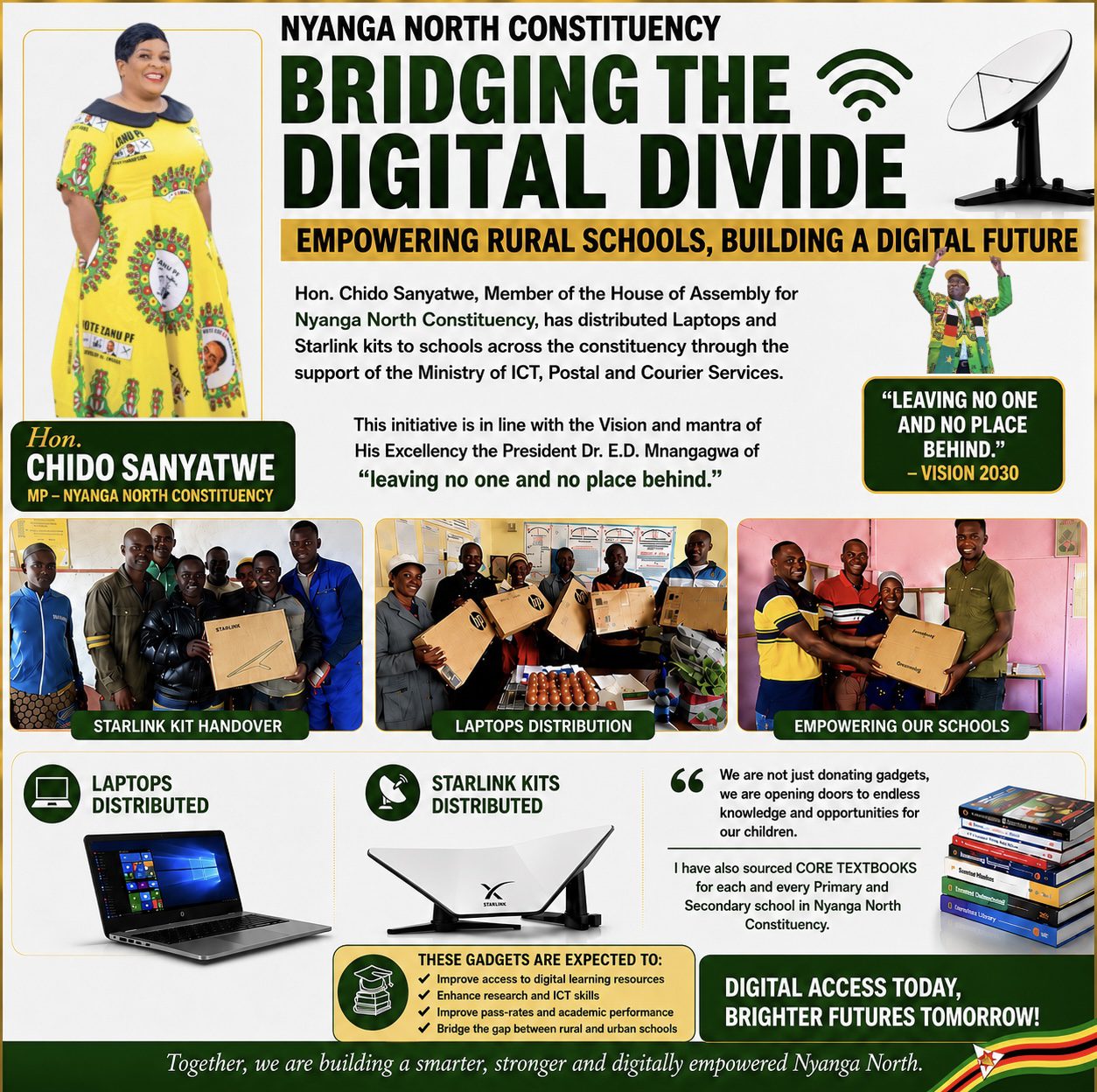
Nyanga North – For decades, many rural schools in Zimbabwe have struggled with limited access to technology, poor internet connectivity, and shortages of modern learning tools, creating a wide educational gap between urban and rural learners. In Nyanga North Constituency, however, a new chapter is beginning to unfold as schools start embracing digital learning through a major technology empowerment programme spearheaded by the Member of the House of Assembly for Nyanga North Constituency, Chido Sanyatwe.
In what has been described by many residents and education stakeholders as a transformative initiative, Hon. Sanyatwe recently distributed laptops and Starlink internet kits to several schools across the constituency in a determined effort to bridge the digital divide between rural and urban schools.
The programme, which was made possible through support from the Ministry of ICT, Postal and Courier Services, is expected to significantly improve access to digital learning, research opportunities and modern educational resources for learners in some of the most remote parts of Nyanga North.
The initiative aligns with the national development philosophy of His Excellency the President of the Republic of Zimbabwe, Emmerson Dambudzo Mnangagwa, whose governance mantra of “leaving no one and no place behind” continues to shape developmental programmes across the country.
Speaking during the distribution exercises, Hon. Sanyatwe emphasized the importance of ensuring that rural learners are not excluded from the rapidly evolving digital world.
“Our children in rural communities deserve the same opportunities as those in urban areas. Technology is now central to education, communication and national development. We cannot afford to leave our learners behind,” she said.
Under the programme, laptops were distributed to Kute High School in Ward 14 and Kazozo Secondary School in Ward 3. The schools, which have long faced technological limitations, are expected to immediately benefit from enhanced digital learning capacity.
Teachers and school administrators welcomed the development, describing it as a game changer for both learners and educators.
At Kute High School, excitement was visible among students who gathered to witness the handover ceremony. For many learners, it was their first close interaction with modern computer equipment provided directly to their school.
“This is a huge opportunity for our learners,” said one teacher at the school. “Many of our pupils have only heard about some digital learning platforms in theory, but now they will have direct access to technology which improves research, computer literacy and classroom learning.”
The digital empowerment programme also saw the distribution of Starlink internet kits to several schools across the constituency. Beneficiaries included Renzva Primary School in Ward 27, Sande Munemo Secondary School in Ward 6, Chatindo Secondary School in Ward 11, Sanzvenga Primary School in Ward 13 and Nyamubarawanda Secondary School in Ward 13.
The installation of Starlink internet services is expected to dramatically improve internet access in schools that previously struggled with poor or non-existent connectivity.
For years, many rural schools have operated without reliable internet access, making it difficult for learners and teachers to access online educational resources, communicate efficiently, or participate in modern e-learning initiatives. In some cases, schools depended entirely on outdated textbooks and limited printed material.
Education experts believe the arrival of internet connectivity in such schools could revolutionize teaching and learning outcomes.
“With internet access, learners can now research, access online libraries, engage with digital learning materials and even participate in virtual educational programmes,” said an education official in the district. “This is no longer just about computers. It is about creating equal educational opportunities.”
Community members across Nyanga North have also praised the programme, saying it reflects practical leadership that directly impacts ordinary people.
Parents expressed optimism that improved access to technology would enhance pass rates and increase opportunities for rural learners to compete nationally and internationally.
Hon. Sanyatwe noted that the distribution of laptops and internet kits is only the beginning of a broader education support programme targeting schools within the constituency.
She revealed that she had also sourced core textbooks for every Primary and Secondary school in Nyanga North Constituency, with schools expected to receive their consignments soon.
The announcement was received with excitement by teachers and parents alike, especially in schools where shortages of learning materials continue to affect effective teaching.
The planned distribution of textbooks is expected to complement the digital learning programme by ensuring that learners have both physical and digital educational resources available to them.
Education stakeholders say the combined provision of textbooks, laptops and internet connectivity has the potential to transform educational performance across the constituency.
Rural schools in Zimbabwe have often faced unique challenges including inadequate infrastructure, teacher shortages, poor network coverage and limited access to modern educational tools. As a result, learners from remote areas frequently compete at a disadvantage compared to their urban counterparts.
However, the latest developments in Nyanga North are increasingly being viewed as part of a wider national effort to modernize education and ensure inclusive development.
The Government has in recent years intensified efforts to digitize schools, expand internet connectivity and improve access to Information Communication Technologies as part of the country’s education transformation agenda.
Analysts believe initiatives such as the one being implemented in Nyanga North are critical in preparing learners for the demands of the modern world, where digital literacy has become an essential skill.
Beyond improving classroom learning, access to technology is also expected to expose learners to innovation, entrepreneurship and global opportunities that were previously beyond reach for many rural students.
For communities in Nyanga North, the programme has become more than just a distribution exercise. It has become a symbol of hope, inclusion and progress.
As schools begin to integrate technology into daily learning, many believe the initiative could become a turning point in narrowing educational inequalities between rural and urban Zimbabwe.
With more schools expected to benefit in the coming months, optimism continues to grow that the digital transformation underway in Nyanga North will not only improve pass rates, but also empower a new generation of learners equipped to thrive in an increasingly digital world.