

Venice, Italy – In the winding canals and centuries old architecture of Venice, where the world’s most influential voices in contemporary art converge every two years, Zimbabwe has once again stepped onto the global stage with confidence, depth and unmistakable cultural conviction.
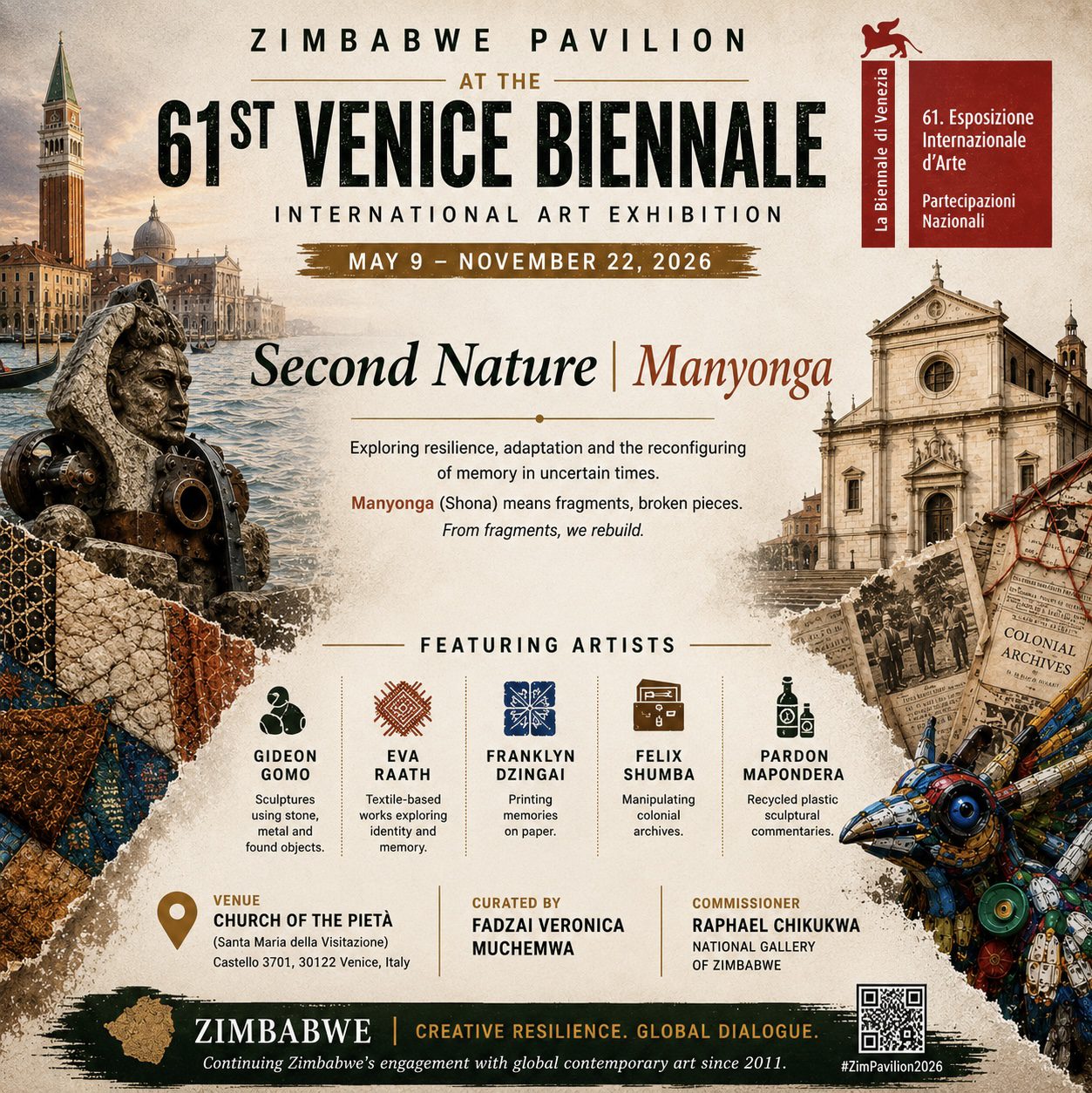
At the 61st edition of the Venice Biennale, running from May 9 to November 22, Zimbabwe has unveiled its eighth national pavilion under the evocative title “Second Nature | Manyonga,” an exhibition that speaks powerfully to fractured histories, environmental crises, collective memory and the enduring resilience of humanity.
Housed at the historic Church of the Pietà, also known as Santa Maria della Visitazione, the Zimbabwe Pavilion has emerged as one of Africa’s most intellectually compelling artistic statements at this year’s exhibition. Curated by Fadzai Veronica Muchemwa and commissioned by Raphael Chikukwa of the National Gallery of Zimbabwe, the pavilion brings together five visionary artists whose works interrogate the brokenness of the modern world while simultaneously imagining pathways toward healing and renewal.
The title “Manyonga,” derived from the Shona language, translates loosely to “fragments” or “broken pieces.” Yet within Zimbabwe’s pavilion, those fragments are transformed into sites of possibility. The exhibition reflects on how communities reconstruct themselves after displacement, ecological destruction, colonial violence and social upheaval. It is an exploration of survival in uncertain times, a deeply African meditation on adaptation and continuity.
At a time when global conversations are increasingly centred on climate anxiety, migration, war and identity, Zimbabwe’s contribution refuses to surrender to despair. Instead, it offers a nuanced Afrocentric perspective rooted in memory, spirituality and communal resilience.
The pavilion’s conceptual heartbeat lies in its ability to merge the local and the universal. While the themes arise from Zimbabwean lived experiences and indigenous philosophies, the questions posed resonate across continents. What remains after rupture? How do societies rebuild from broken histories? Can fragments become foundations for a new future?
These questions echo throughout the exhibition space.
Artist Gideon Gomo presents monumental sculptural works assembled from stone, metal and found objects. His pieces feel archaeological and futuristic at once, as if excavated from both ancestral landscapes and post industrial ruins. Gomo’s practice reflects the enduring relationship between Zimbabwean communities and the land, but also the scars left behind by extraction, displacement and environmental degradation. The tension between permanence and decay is central to his work, reminding audiences that resilience is often forged through hardship.
Eva Raath’s textile installations introduce a softer but equally powerful emotional register. Through layered fabrics, stitched surfaces and tactile compositions, she explores themes of identity, memory and belonging. Her work reflects the invisible threads that connect generations, particularly in societies negotiating cultural transformation and historical trauma. The textures and patterns within her pieces evoke domestic histories, migration stories and intimate emotional landscapes often overlooked in mainstream narratives about Africa.
Franklyn Dzingai approaches memory through printmaking and paper based works that resemble fading archives of lived experience. His artistic language captures the fragility of remembrance in a rapidly changing world. By imprinting memories onto paper surfaces, Dzingai examines how histories are preserved, erased and reconstructed. His work becomes a metaphor for collective consciousness itself, where traces of the past linger even when partially obscured.
Felix Shumba’s contribution confronts colonial histories directly through the manipulation of archival materials. In a bold artistic intervention, Shumba destabilises traditional colonial narratives by reworking historical imagery and records. His practice interrogates who controls memory, who writes history and whose voices have historically been silenced. Through distortion, layering and reinterpretation, Shumba symbolically reclaims agency over African historical representation.
Meanwhile, Pardon Mapondera transforms discarded plastic materials into intricate sculptural forms that speak urgently to ecological collapse and consumer excess. His work is both environmental commentary and artistic reclamation. What society discards, Mapondera reshapes into objects of meaning and beauty. In doing so, he challenges audiences to reconsider notions of waste, value and sustainability in an era dominated by environmental uncertainty.
Together, these five artists create a cohesive but multidimensional conversation about survival, reconstruction and transformation. Their works move beyond aesthetic spectacle into the realm of philosophical inquiry and cultural reflection.
Zimbabwe’s presence at the Venice Biennale is also significant within the broader trajectory of African contemporary art. Since debuting at the prestigious exhibition in 2011, Zimbabwe has steadily built a reputation for presenting intellectually rigorous and culturally grounded exhibitions. Each pavilion has expanded the visibility of Zimbabwean artists within international art discourse while reinforcing the importance of African perspectives in shaping global cultural conversations.
This sustained participation reflects not only artistic ambition but institutional commitment. Under the stewardship of Commissioner Raphael Chikukwa and the National Gallery of Zimbabwe, Zimbabwe has consistently demonstrated that contemporary African art is not peripheral to the global art world but central to its future.
The Venice Biennale itself remains one of the most influential platforms in international contemporary art. Countries use their national pavilions not merely to showcase artistic talent but to articulate identity, politics and cultural philosophy. For Zimbabwe, the pavilion represents more than exhibition space. It is an act of cultural diplomacy and intellectual assertion.
Importantly, “Second Nature | Manyonga” arrives at a moment when African artistic voices are gaining unprecedented global recognition. Across museums, biennales and cultural institutions worldwide, there is growing acknowledgement that African artists are reshaping contemporary artistic language through perspectives deeply rooted in histories of resilience, spirituality and communal imagination.
Zimbabwe’s pavilion contributes meaningfully to that shift.
What distinguishes the exhibition is its refusal to flatten African experiences into simplistic narratives of suffering or triumph. Instead, the artists embrace complexity. Fragmentation exists alongside regeneration. Memory coexists with forgetting. Destruction gives birth to reinvention.
The symbolism of “Manyonga” carries profound resonance for Zimbabwe itself. Like many African nations navigating the afterlives of colonialism, economic instability and environmental pressures, Zimbabwe continues to reconstruct itself from fractured histories. Yet embedded within that process is extraordinary creativity and endurance.
In many ways, the pavilion mirrors the spirit of Zimbabwean society, where innovation often emerges from adversity and where communities continue to preserve cultural memory despite social transformation.
Visitors entering the historic Church of the Pietà encounter not just artworks but layered narratives about humanity’s capacity to endure. The ancient Venetian architecture provides a striking dialogue with the contemporary African works on display. Within those sacred walls, Zimbabwe’s artists challenge audiences to reconsider assumptions about Africa, modernity and the future itself.
As thousands of international visitors, curators, collectors and critics pass through the pavilion over the coming months, Zimbabwe’s voice will once again reverberate across the global cultural landscape.
And perhaps that is the deeper triumph of “Second Nature | Manyonga.” It reminds the world that even in fragmented times, art remains a powerful tool for stitching broken pieces back together.
From Harare to Venice, Zimbabwe is not merely participating in the global conversation. It is helping redefine it.