President Mnangagwa Rallies Exporters, Value Addition Now a National Economic Imperative
4 min read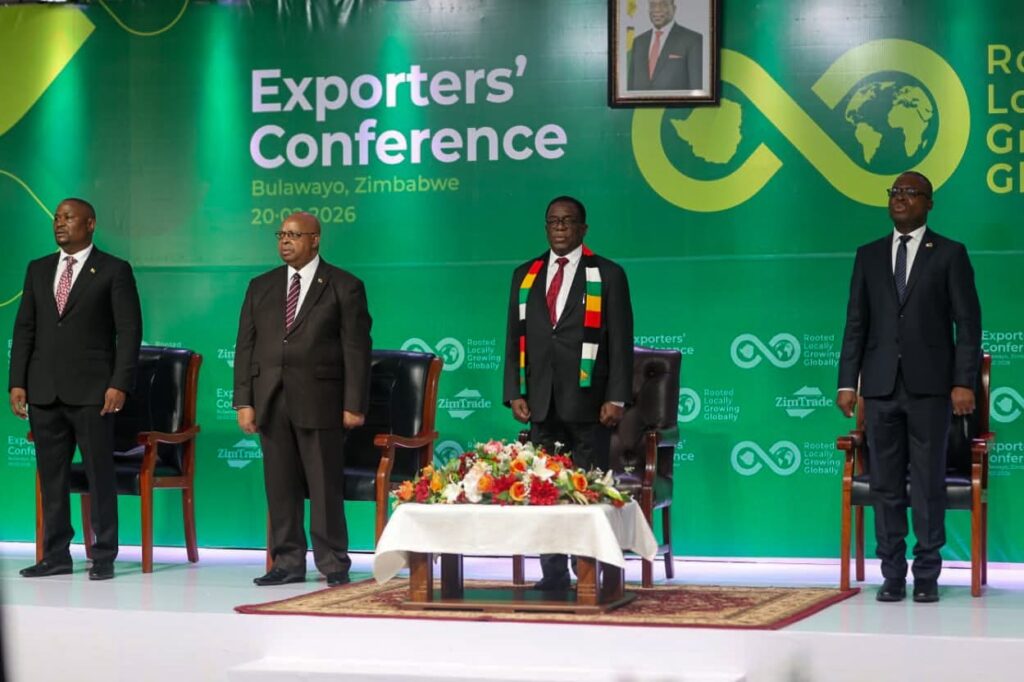
Bulawayo – When His Excellency The President Dr. ED. Mnangagwa rose to deliver the Keynote Address at the 2026 ZimTrade Annual Exporters’ Conference, the message carried both urgency and conviction. Zimbabwe, he declared, must no longer be satisfied with exporting raw potential. It must export value, innovation and finished products that command higher returns on the global market.
Held in the industrial hub of Bulawayo under the theme “Rooted Locally, Growing Globally,” the conference brought together exporters, captains of industry, small and medium enterprises, policymakers and trade development experts. The atmosphere reflected a country at a crossroads, determined to recalibrate its export strategy in line with national aspirations.
Anchoring his address within the framework of National Development Strategy 2, His Excellency made it clear that export oriented production is no longer a matter of corporate ambition alone. It is now a national economic imperative.
For decades, Zimbabwe has relied heavily on the export of primary commodities. Minerals have often left the country unprocessed. Agricultural produce has crossed borders with minimal value addition. While such exports generate foreign currency, they do not maximise earnings nor create sufficient employment opportunities.
His Excellency was unequivocal. Zimbabwe must earn more from every tonne, every kilogramme and every product it exports. Dependence on raw exports, he said, is neither sustainable nor desirable in an increasingly competitive global economy.
The new trajectory demands local value creation. It demands beneficiation in the mining sector, where raw minerals are processed into higher value products before export. It demands agro processing industries that transform crops and livestock into finished or semi finished goods. It demands revitalised manufacturing capacity capable of meeting regional and international standards. It demands a tourism sector that packages unique experiences in ways that extend visitor stays and increase spending.
From mining and agriculture to manufacturing and tourism, the focus remains on value addition, beneficiation, competitiveness and integration into regional and global value chains.
Such integration is not automatic. It requires deliberate policy support and consistent investment. His Excellency assured delegates that Government will continue simplifying trade processes, modernising border systems and strengthening infrastructure to facilitate smoother movement of goods. Digitalisation of customs procedures and the upgrading of ports of entry are central to this effort.
Infrastructure development remains a pillar of this strategy. Efficient roads, reliable rail networks and stable energy supply are essential if Zimbabwean products are to compete effectively in both price and quality. The President emphasised that Government is committed to creating an enabling environment that reduces production costs and enhances productivity.
Economic diplomacy, too, is being advanced as a strategic tool. Through strengthened bilateral and multilateral engagements, Zimbabwe seeks to unlock new markets and deepen existing trade partnerships. Expanding market access is not merely about increasing volumes. It is about positioning Zimbabwean products in premium segments of regional and global markets.
However, His Excellency did not place the burden of transformation solely on Government. He issued a direct challenge to exporters, entrepreneurs and industrialists.
Small and medium enterprises, he noted, are critical drivers of diversification. Their agility and innovation allow them to tap into niche markets and respond quickly to emerging trends. With the right support and strategic focus, SMEs can significantly expand Zimbabwe’s export base.
The President also placed particular emphasis on youth and women led enterprises. In an era shaped by technology, digital commerce and creative industries, young Zimbabweans possess the potential to redefine how the nation competes globally. Women entrepreneurs, already active across agriculture, crafts, manufacturing and services, must be empowered to scale up and access export markets.
No export strategy can afford to sideline such vital constituencies.
The African Continental Free Trade Area featured prominently in the address. The AfCFTA opens access to a vast single African market, presenting unprecedented opportunities for Zimbabwean producers. Yet opportunity alone does not guarantee success. Companies must understand regulatory frameworks, standards and rules of origin to compete effectively within this continental market.
His Excellency urged exporters to seize opportunities under the AfCFTA and beyond. Preparation, compliance and competitiveness will determine who thrives in this new trade environment.
The choice of Bulawayo as host city carried symbolic weight. Once the beating heart of Zimbabwe’s manufacturing sector, the city represents both the legacy of industrial strength and the promise of revival. Hosting the conference there signalled a commitment to reindustrialisation and balanced national development.
Economic analysts attending the conference observed that value addition has multiplier effects across the economy. Processing minerals locally stimulates downstream industries. Agro processing creates demand for packaging, transport and marketing services. Manufacturing supports skilled employment and technological advancement. In this context, export transformation becomes a vehicle for structural economic change.
Under National Development Strategy 2, economic growth is inseparable from industrialisation, innovation and resilience. Export oriented production aligns seamlessly with these objectives by enhancing productivity and strengthening foreign currency generation.
Yet challenges remain. Access to affordable finance, compliance with stringent international standards and energy stability continue to test producers. Global markets are competitive and unforgiving.
Despite these realities, the tone set by His Excellency was resolute. Zimbabwe cannot afford complacency. It must move decisively from exporting raw materials to exporting refined, value added products that reflect its ingenuity and resource wealth.
The theme “Rooted Locally, Growing Globally” encapsulates this dual commitment. Rooted locally signifies strengthening domestic capacity, empowering communities and retaining economic value within the country. Growing globally reflects ambition, integration and confidence on the international stage.
As delegates departed the conference halls in Bulawayo, the message remained clear. Export transformation is not a slogan. It is a national project demanding coordination between Government and the private sector, between established corporations and emerging enterprises.
Zimbabwe’s future prosperity, as articulated by His Excellency The President Dr. ED. Mnangagwa, hinges on how effectively the nation converts its abundant resources into high value products that compete and win in global markets.
The era of exporting raw potential is drawing to a close. The era of exporting value must now define Zimbabwe’s economic story.
About The Author