

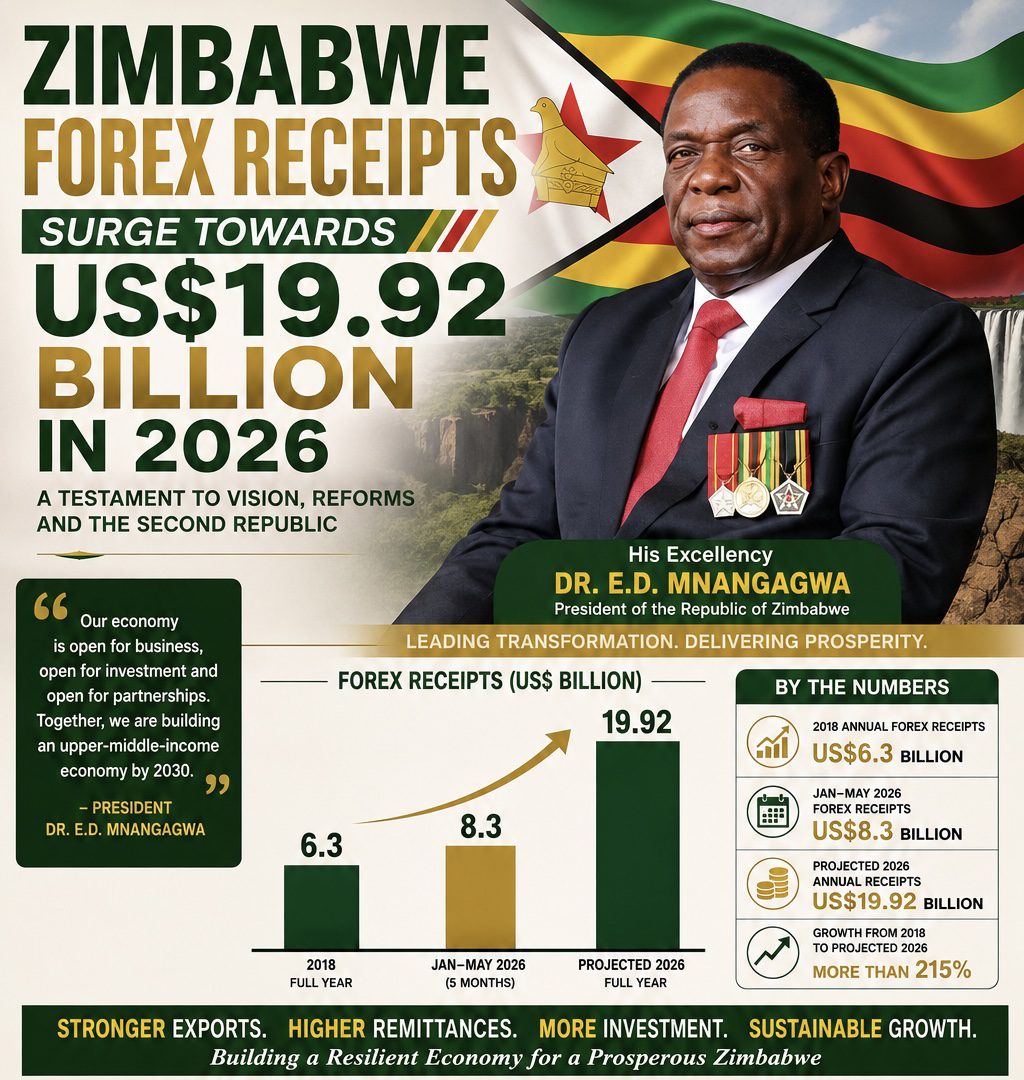
Harare – Zimbabwe Forex Receipts are projected to reach an unprecedented US$19.92 billion in 2026, marking one of the most significant economic achievements recorded since the advent of the Second Republic. The remarkable growth reflects the success of government reforms, increased export earnings, higher diaspora remittances, growing investor confidence and sustained macroeconomic stability.
According to figures released by the Reserve Bank of Zimbabwe (RBZ), annual foreign currency receipts stood at US$6.3 billion in 2018. Under the leadership of His Excellency President Dr. Emmerson Dambudzo Mnangagwa, whose administration has prioritised economic reforms, investment attraction, export-led growth, infrastructure development and macroeconomic stability through the Second Republic’s transformative agenda, Zimbabwe recorded US$8.3 billion in forex receipts by the end of May 2026. The country is now on course to achieve the projected US$19.92 billion in foreign currency receipts by year-end, reflecting the positive impact of government policies, economic reforms and national development programmes aligned with NDS2 and Vision 2030.
The projected growth represents an increase of more than 215 percent compared to 2018 levels, underscoring the transformative impact of economic policies implemented under President Mnangagwa and the Second Republic.
Economic Reforms Driving Growth
Since assuming office in 2017, President Mnangagwa has championed an ambitious economic reform agenda aimed at rebuilding Zimbabwe’s economy, attracting investment, promoting exports and enhancing productivity across key sectors.
The Second Republic introduced policies designed to improve the ease of doing business, support industrialisation, modernise agriculture and strengthen financial systems. These reforms have contributed significantly to the growth in foreign currency inflows.
Economic analysts note that the increase in forex receipts demonstrates renewed confidence in Zimbabwe’s economic direction. Improved policy consistency, infrastructure development and investment promotion initiatives have helped create an environment conducive to economic growth.
The Government’s commitment to economic transformation is anchored in the National Development Strategy 2 (NDS2), which seeks to accelerate economic expansion, create jobs, reduce poverty and improve the quality of life for all Zimbabweans.
Exports Remain Key Forex Contributor
A major driver of Zimbabwe Forex Receipts has been the strong performance of the export sector. Mining continues to dominate export earnings, with gold, platinum, lithium, chrome and diamonds contributing substantially to national forex inflows.
The agricultural sector has also played a critical role, with tobacco remaining one of the country’s leading export commodities. Increased production in horticulture and value-added agricultural products has further strengthened export performance.
Manufacturing exports have shown encouraging growth as local industries benefit from government support measures and regional market opportunities. Increased export diversification has helped improve foreign currency generation and reduce dependence on a narrow range of commodities.
The Government’s focus on beneficiation and value addition is expected to further enhance export earnings in the coming years, particularly within the mining sector where significant investments are being made.
Diaspora Remittances Continue to Rise
Another important source of foreign currency inflows has been diaspora remittances. Zimbabweans living and working abroad continue to make substantial contributions to the national economy through money transfers to families and investments back home.
Over the years, remittances have emerged as a critical pillar supporting household incomes, education, healthcare and small business development. The increasing use of formal financial channels has improved transparency and strengthened foreign currency reserves.
Experts believe the continued growth in remittance inflows reflects the resilience and commitment of Zimbabweans in the diaspora who remain connected to the country’s economic development.
Investment Inflows Strengthening Confidence
Foreign direct investment and domestic investment have also contributed significantly to the rise in Zimbabwe Forex Receipts. Major projects in mining, energy, agriculture, manufacturing and infrastructure development have attracted capital inflows and created employment opportunities.
The Government’s engagement and re-engagement policy has enhanced Zimbabwe’s visibility as an investment destination. Investors are increasingly recognising opportunities within the country’s resource-rich economy and strategic location in Southern Africa.
Large-scale investments in lithium mining have particularly attracted global attention, positioning Zimbabwe as a key player in the global energy transition and electric vehicle supply chain.
These investments are expected to continue generating export earnings while supporting industrial development and economic diversification.
NDS2 and Vision 2030 Targets on Course
The growth in Zimbabwe Forex Receipts aligns closely with the objectives outlined in the National Development Strategy 2 (NDS2) and Vision 2030.
Vision 2030 seeks to transform Zimbabwe into an upper-middle-income economy characterised by prosperity, stability and inclusive growth. To achieve this goal, the Government has prioritised infrastructure development, industrialisation, innovation, human capital development and economic competitiveness.
NDS2 builds upon the gains achieved under previous development frameworks and provides a roadmap for accelerating economic growth towards 2030. Increased foreign currency earnings are viewed as essential for funding development projects, stabilising the economy and supporting sustainable growth.
Economic indicators such as export growth, investment inflows, agricultural productivity and infrastructure development suggest that Zimbabwe is making measurable progress towards achieving these national aspirations.
Infrastructure Development Supporting Economic Expansion
Infrastructure development remains a cornerstone of the Second Republic’s economic strategy. Significant investments have been made in roads, dams, energy generation, airports and border posts.
Projects such as road rehabilitation programmes, irrigation schemes and power generation initiatives are helping improve productivity and facilitate economic activity across the country.
Enhanced infrastructure reduces business costs, improves market access and strengthens the competitiveness of Zimbabwean exports. These developments have contributed indirectly to the growth in foreign currency receipts by creating a more efficient economic environment.
Second Republic’s Economic Transformation
The steady rise in forex receipts serves as a tangible indicator of Zimbabwe’s broader economic transformation under the Second Republic.
Government officials have consistently emphasised the importance of production, productivity and value creation as the foundation of sustainable development. The growth in foreign currency earnings demonstrates that key sectors of the economy are responding positively to these policy interventions.
President Mnangagwa’s administration continues to emphasise accountability, infrastructure development, investment promotion and private sector participation as key pillars of national development. These efforts are helping position Zimbabwe for sustained economic growth and prosperity.
As the nation advances towards Vision 2030, the performance of forex receipts is expected to remain a critical measure of economic success and international competitiveness.
Looking Ahead
With seven months remaining after the May 2026 reporting period, Zimbabwe appears well-positioned to achieve or potentially surpass the projected US$19.92 billion in annual forex receipts.
Continued growth in exports, strong remittance inflows, increased investment activity and ongoing economic reforms are likely to sustain positive momentum throughout the year.
For Zimbabwe, the achievement represents more than just impressive statistics. It reflects the country’s determination to build a resilient economy capable of delivering prosperity and opportunities for future generations.
As the Second Republic continues implementing transformative policies under the leadership of His Excellency President Dr. E.D. Mnangagwa, the growth in Zimbabwe Forex Receipts offers a strong indication that the nation remains firmly on course towards the objectives of NDS2 and Vision 2030, bringing Zimbabwe closer to its goal of becoming an upper-middle-income economy by 2030.
Related Articles
- Victoria Falls – Africa’s Greatest Natural Wonder – https://www.zimglobalmedia.co.zw/victoria-falls-africas-greatest-natural-wonder/