

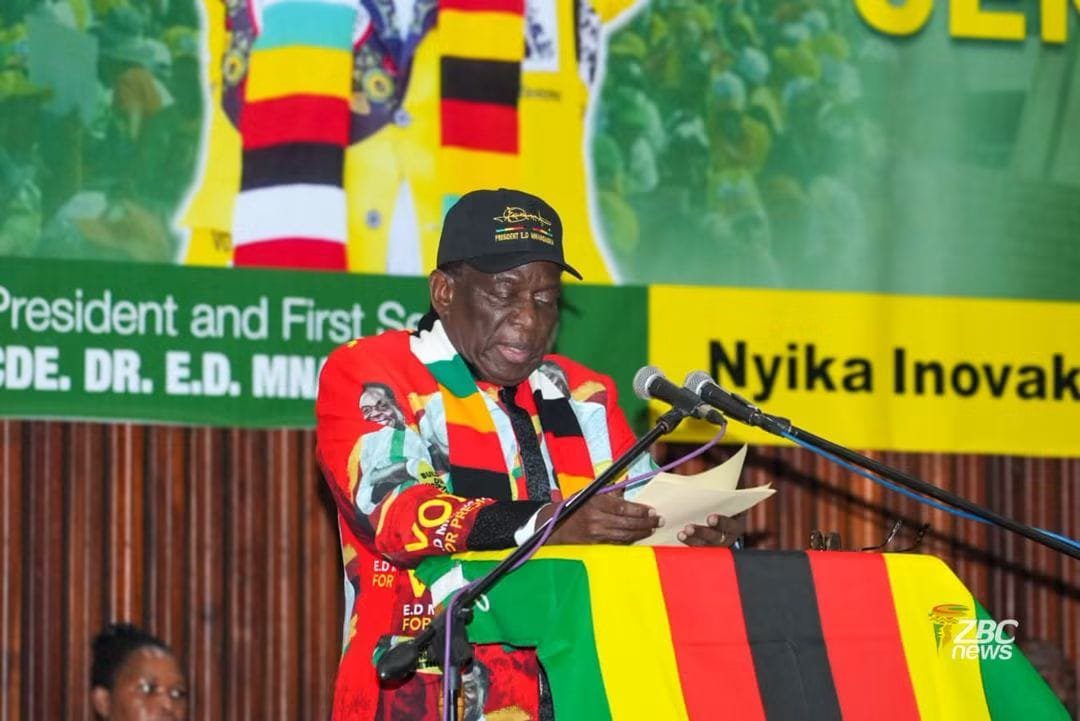
ZANU PF HQ, HARARE – President Mnangagwa 27th National Consultative Assembly address set the tone for the ruling ZANU PF party’s strategic direction as His Excellency President Dr. Emmerson Dambudzo Mnangagwa officially opened the 27th Ordinary Session of the National Consultative Assembly, calling for unity, ideological discipline, accelerated development and unwavering commitment to Zimbabwe’s Vision 2030.
Addressing delegates drawn from across the country, President Mnangagwa commended party members for their dedication and steadfast commitment to the revolutionary ideals that have guided ZANU PF since the liberation struggle. He said the National Consultative Assembly remains one of the party’s most important decision-making platforms, providing leadership and strategic direction as Zimbabwe continues on its development trajectory.
The President said the Assembly comes at a time when Zimbabwe is registering significant milestones in economic growth, infrastructure development, agricultural production and international engagement under the Second Republic. He said these achievements are in line with the country’s National Development Strategy 2 (NDS2) and the broader Vision 2030 agenda, whose goal is to transform Zimbabwe into an upper-middle-income economy by the end of the decade.
President Mnangagwa reiterated that ZANU PF remains committed to fulfilling its revolutionary mandate of empowering Zimbabweans through inclusive development, industrialisation and modernisation. He said the party’s policies continue to place the people at the centre of national development while ensuring that no one and no place is left behind.
The President noted that peace and unity continue to define Zimbabwe’s national character, adding that democracy has continued to mature through dialogue, tolerance and constitutional governance. He urged party members to safeguard the country’s hard-won independence by rejecting divisions and remaining united in pursuit of national prosperity.
A solemn moment marked the beginning of proceedings as delegates observed a minute of silence in honour of fallen liberation heroes and heroines whose sacrifices secured Zimbabwe’s independence. President Mnangagwa also paid tribute to the late Father Zimbabwe, Dr. Joshua Mqabuko Nkomo, acknowledging his enduring contribution to the liberation struggle, national reconciliation and unity.
He said the liberation legacy must remain alive among younger generations through deliberate efforts to preserve historical records and institutional memory. To this end, President Mnangagwa called for the establishment of a modern archive that documents the history, milestones and contributions of ZANU PF and the liberation movement for future generations.
The President emphasised that preserving the party’s history is not only important for historical reference but also for strengthening ideological consciousness among members. He encouraged senior cadres to mentor emerging leaders by passing on valuable lessons from the liberation struggle and the country’s political development.
President Mnangagwa said the National Consultative Assembly carries the responsibility of providing ideological clarity while shaping the strategic direction of the revolutionary party. He challenged delegates to remain focused on implementing resolutions that improve people’s livelihoods and strengthen national institutions.
The Head of State also urged all party structures to intensify preparations for the forthcoming 23rd National People’s Conference, which will be hosted in Mashonaland West Province. He said the conference presents another opportunity for members to assess progress, refine policies and strengthen grassroots mobilisation ahead of future programmes.
According to President Mnangagwa, continuous political education remains central to building capable leadership. He highlighted the importance of leadership seminars, ideological workshops and structured training programmes that equip members with the knowledge and skills required to effectively serve communities while defending the party’s revolutionary values.
The President also challenged the party to embrace innovation and digital transformation in its operations. He called for improved data management systems, modern communication platforms and enhanced administrative efficiency to ensure that the organisation remains responsive to the evolving needs of Zimbabweans.
He said technology should become an important tool in strengthening organisational effectiveness while improving communication between national leadership and grassroots structures. Efficient information management, he added, will contribute to better policy implementation and service delivery.
President Mnangagwa further underscored the importance of youth empowerment through entrepreneurship, vocational skills development and community-based economic initiatives. He said programmes aimed at equipping young people with productive skills are critical in reducing unemployment while stimulating sustainable economic growth.
Infrastructure development also featured prominently in the President’s address. He noted that government continues to invest heavily in roads, schools, health facilities, dams, irrigation projects and energy infrastructure to create an enabling environment for investment and inclusive national development.
Turning to agriculture, President Mnangagwa celebrated another successful farming season, highlighting record wheat production and the continued expansion of irrigation infrastructure across the country. He said Zimbabwe’s food security agenda is yielding tangible results through deliberate investments in climate-resilient agriculture, mechanisation and farmer support programmes.
He noted that irrigation development is enabling year-round agricultural production while reducing dependence on rainfall. Increased productivity in both crop and livestock sectors, he said, is contributing significantly to rural incomes and national food self-sufficiency.
The President also pointed to the mining sector as another major pillar of economic transformation. He encouraged greater mineral beneficiation and value addition, saying Zimbabwe must maximise returns from its abundant natural resources by processing minerals locally before export.
Industrialisation, he said, remains the cornerstone of economic transformation, with value addition creating employment opportunities while increasing export earnings. This approach aligns with government’s broader industrial policy and economic modernisation agenda.
On the international front, President Mnangagwa applauded Zimbabwe’s growing diplomatic influence. He highlighted the country’s successful election to a non-permanent seat on the United Nations Security Council as evidence of increasing international confidence in Zimbabwe’s foreign policy and diplomatic engagement.
The President also noted that Zimbabwe is preparing to assume the Chairmanship of the Common Market for Eastern and Southern Africa (COMESA), a development expected to further strengthen regional integration, trade cooperation and investment opportunities.
He added that Zimbabwe continues to expand bilateral and multilateral relations with friendly nations across Africa and the world, creating new opportunities for trade, investment, technology transfer and infrastructure financing.
President Mnangagwa concluded by urging every party member to remain disciplined, patriotic and committed to serving the people. He said Zimbabwe’s future depends on unity of purpose, responsible leadership and collective participation in national development programmes.
As the Second Republic continues implementing transformative policies under NDS2 and Vision 2030, the resolutions emerging from the 27th Ordinary Session of the National Consultative Assembly are expected to reinforce Zimbabwe’s development agenda while strengthening ZANU PF’s organisational capacity ahead of future national programmes.
Political analysts say the address reaffirmed government’s emphasis on peace, economic growth, agricultural productivity, infrastructure development and international engagement, while placing renewed focus on ideological renewal and preserving the country’s liberation heritage.
With preparations for the 23rd National People’s Conference now gathering momentum, party structures across Zimbabwe are expected to intensify mobilisation efforts while implementing programmes aimed at improving livelihoods and accelerating national development.
RELATED READS:
[…] President Mnangagwa 27th National Consultative Assembly: ZANU PF Charts Course for Unity, Economic G…Kuwadzana Police Station Groundbreaking Advances Vision 2030 and NDS2 Development Agenda 10 / 100 Powered by Rank Math SEO SEO Score […]