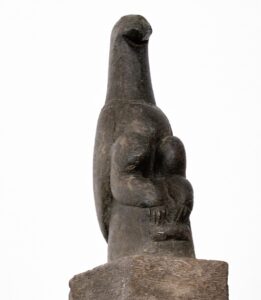
Zimbabwe Reclaims the Soul of Its Heritage…
4 min read
…as Soapstone Bird, Ancestral Remains are Repatriated
Cape Town, South Africa – In a moment heavy with history, memory and spiritual significance, Zimbabwe in the Second Republic under the leadership of His Excellency the President Dr. ED. Mnangagwa received the return of one of its most sacred cultural symbols, the Zimbabwe Soapstone Bird, alongside ancestral human remains that had been taken during the colonial era.
The handover ceremony, led by South Africa’s Minister of Sport, Arts and Culture, Gayton McKenzie, unfolded in Cape Town, marking not just a diplomatic gesture, but a profound act of restoration, healing and African dignity.
The ceremony, held at the Iziko South African Museum, brought together officials, cultural custodians and representatives from both nations.
Draped in solemn respect, eight coffins containing ancestral remains stood as silent witnesses to a painful past, one defined by displacement, exploitation and the erasure of African humanity.
The Zimbabwe bird and accompanying remains will be formally presented to the President His Excellency Dr. Mnangagwa at a State House by the Ministry of Home Affairs and Cultural Heritage before the cultural processes to formally reunite them with motherland are done.
For Zimbabwe, this was never just about artefacts. It was about identity. It was about spirit. It was about bringing home what had always belonged to the land and its people.
The Zimbabwe Bird, carved centuries ago from soapstone at the ancient city of Great Zimbabwe, is no ordinary sculpture.
It is the heartbeat of a civilization. It is a symbol of power, sovereignty and spiritual connection.
Historians trace its origins to between the 11th and 15th centuries, when Great Zimbabwe stood as a thriving political and cultural centre of African excellence.
For generations, the bird has embodied the soul of the nation, appearing on Zimbabwe’s national flag, coat of arms, currency and institutions. Yet for over a century, one of these sacred carvings had been separated from its homeland, taken during colonial plunder and sold into foreign hands.
Its journey into exile told a familiar African story. In the late 19th century, colonial adventurers removed the bird from its sacred pedestal at Great Zimbabwe, severing it from its cultural and spiritual roots.
It eventually came into the possession of British imperialist Cecil John Rhodes, symbolizing the broader theft of African heritage during that era.
But history, as Africa continues to prove, is not static. It bends. It returns. It remembers.
Nearly 140 years later, that same bird, known as Chapungu, began its journey home.
Speaking at the ceremony, Minister McKenzie emphasized that the return of such artefacts was not merely symbolic. It was about justice. It was about restoring memory and dignity to a people whose history had been fragmented. He acknowledged that when something sacred is taken from a people, a part of their story is taken with it, and that returning it is an act of restoring that story.
The repatriation formed part of a broader continental and global movement demanding the return of African cultural property looted during colonial rule.
Across the continent, nations are increasingly asserting their right to reclaim stolen heritage, challenging institutions and governments that have long held African artefacts in foreign spaces.
Zimbabwe’s case stood as one of the most powerful examples of this movement.
This particular return was especially significant because it involved what officials described as the last and most important of the original Zimbabwe Birds that had remained outside the country.
While others had been returned in the years following independence in 1980, this final piece carried deep symbolic weight, representing closure in a long and painful chapter.
Alongside the bird, the return of ancestral human remains added another layer of emotional gravity. These remains, which had been unethically exhumed during colonial times for research and collection, carried stories that had been silenced.
Their return signal a commitment to restore not only objects, but also human dignity.
Zimbabwean representatives led by Dr Paul Mupira of the National Museums and Monuments of Zimbabwe indicated that once back home, the remains would undergo proper study before being laid to rest in accordance with cultural and spiritual traditions.
This process is expected to reconnect communities with their ancestors, restoring a sacred relationship that had been violently disrupted.
In African cosmology, the living and the departed are never separate. Ancestors are guardians, guides and keepers of wisdom. Their displacement is not just physical, it is spiritual. Their return, therefore, is an act of healing that transcends generations.
The significance of this moment extended beyond Zimbabwe and South Africa. It spoke to a wider African awakening, one that is reclaiming narrative, identity and ownership of history.
From Benin Bronzes to Ethiopian manuscripts, the continent is steadily pushing back against centuries of cultural dispossession.
This handover also reflected growing cooperation among African nations in addressing historical injustices. South Africa’s role in returning the artefacts demonstrated a commitment to continental solidarity and ethical stewardship of heritage.
Institutions like the Iziko Museums of South Africa have increasingly aligned themselves with principles of restorative justice, acknowledging that museums must not only preserve history, but also confront the injustices tied to their collections.
For Zimbabwe, the timing of the return carried additional meaning. Coming just days before the 46th Independence Day celebrations, it serves as a powerful reminder of the country’s journey from colonial subjugation to sovereign identity.
It is a moment where history met the present. Where memory met action. Where loss met restoration.
As the Zimbabwe Bird prepares to take its rightful place once again on home soil, it does so not just as a relic of the past, but as a living symbol of resilience. It stands as a reminder that Africa’s story cannot be told without Africa itself.
This was more than a handover ceremony.
It was a homecoming.
It was justice in motion.
It was Africa remembering itself.