Cämpulung Muscel, Romania – Zimbabwe’s teenage legal champions have conquered Europe, turning months of late night preparation, intense legal research and unwavering determination into a stunning international victory in Romania.
Eight Zimbabwean high school students have been crowned European Moot Court Champions after defeating Azerbaijan in the semi final before overcoming France in the decisive final, producing a remarkable achievement that has placed Zimbabwean youth advocacy firmly on the international stage.
What makes the victory even more striking is the age of the team.
Two of Zimbabwe’s representatives were just 13 years old.
Mukudzei Collen Junior Mharadzano and Sarah Arielle Msipa travelled to Romania alongside teammates aged between 15 and 16, competing against students who were considerably older and, in some cases, as old as 19.
Yet when the judges began asking difficult questions, the teenagers did not retreat.
They argued.
They responded.
They challenged opposing positions.
And they defended Zimbabwe.
The triumph in Câmpulung Muscel is the latest major international success for the Zimbabwe National Moot Court Team and represents the growing strength of high school moot court in Zimbabwe.
Behind the glamour of the European championship, however, lies a much more demanding story.
The journey started in Zimbabwe with approximately 200 students from across the country answering a national call for young people interested in law, advocacy and international competition.
Students from Form 1 through Form 6 were introduced to international humanitarian law and the fundamentals of moot court before facing national selection trials.
The selection process combined virtual assessments with an in person component hosted at Dominican Convent.
Legal professionals and law students from the University of Zimbabwe and Herbert Chitepo Law School were involved in assessing the aspiring competitors.
From that large national pool, eight students eventually emerged to carry the Zimbabwean flag into Europe.
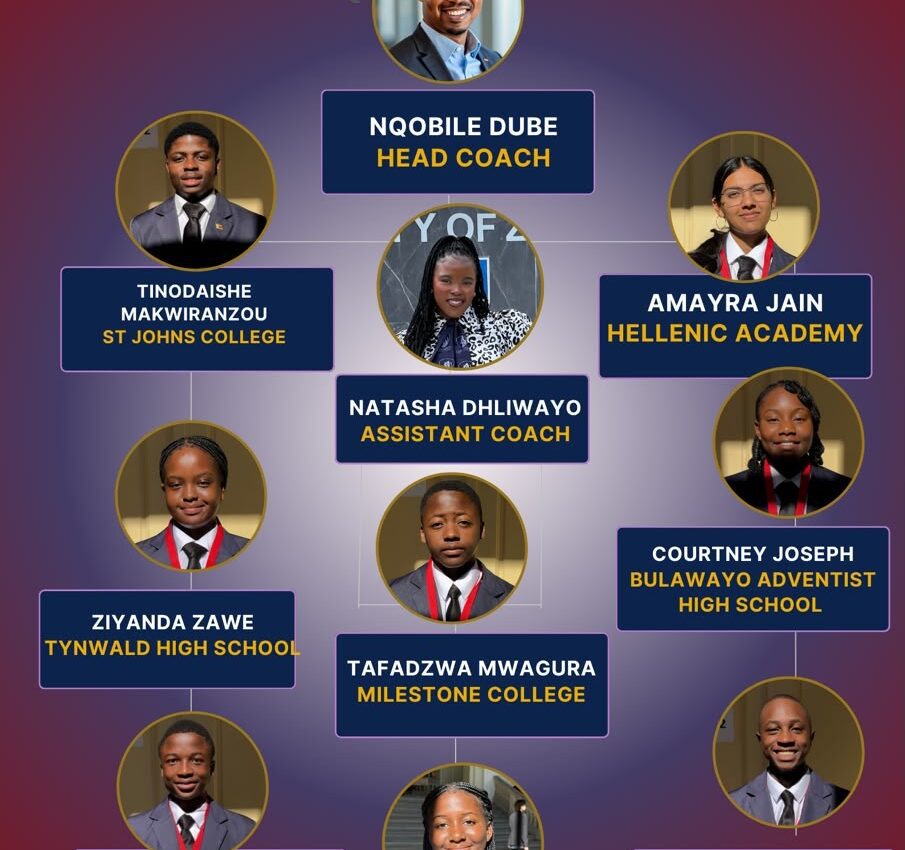
The final squad consisted of Tinodaishe Cole Makwiranzou, 15, of St John’s College, who served as captain; Amyra Jain, 15, of Hellenic Academy, the deputy captain; Ziyanda Inzwirashe Madison Zawe, 15, of Tynwald High School; Giovanni Tawananyasha Nyatsambo, 16, also of Tynwald High School; Tafadzwa Samuel Mwagura, 15, of Milestone College; Mukudzei Collen Junior Mharadzano, 13, of Milestone College; Courtney Falees Joseph, 15, of Bulawayo Adventist School; and Sarah Arielle Msipa, 13, of Celebration International School.
Four boys.
Four girls.
Six schools.
One national team.
The transformation from individual students into an international competition team required extraordinary commitment.
Moot court is not a competition where students can simply memorise a prepared speech and hope for the best.
The competitors must understand the law behind their arguments, research legal authorities, prepare written submissions and then defend their positions before judges who are free to interrupt them with questions.
They must also understand the opposing side.
The Zimbabwean students prepared arguments for both prosecution and defence, forcing them to study the fictional case from competing perspectives.
Because the students came from different schools and locations, much of the preparation took place online.
Training sessions regularly stretched from approximately 6pm until 10pm.
For teenagers who still had school assignments, examinations and family responsibilities, those four hour evening sessions demanded discipline.
The coaching programme was led by Advocate Nqobile Dube, founder and head coach of Ideas Matter Academy, together with assistant coaches.
The objective was bigger than teaching the students how to deliver courtroom speeches.
They were being trained to analyse, reason, listen, adapt and think like advocates.
Then came the international test.
The competition placed the Zimbabweans in a simulated International Criminal Court case involving a fictional conflict between two states, Valdris and Solvane, and the prosecution of Admiral Kaspar Selden.
The case required the competitors to grapple with complex questions of international criminal and humanitarian law.
Among the issues were temporal jurisdiction, perfidy, attacks against civilians and environmental damage during armed conflict.
The fictional case also involved the MV Arvellan passenger ferry, which struck a mine and resulted in the deaths of 89 people, including 17 children.
Another part of the case centred on the MT Hestvar oil tanker, which struck another mine and caused a major oil spill that severely damaged the fictional Haevar Banks.
The young Zimbabweans had to turn those facts into legal arguments.
They had to understand the relevant principles.
They had to anticipate the opposing team’s response.
And then they had to answer questions from judges who could expose weaknesses in their arguments at any moment.
The oral advocacy component left little room for hesitation.
Each substantive advocacy segment was timed, with rebuttal and surrebuttal adding another layer of pressure.
The students therefore needed genuine understanding rather than memorised answers.
That preparation would prove decisive.
Among the delegation were teenagers whose individual profiles already demonstrated an impressive commitment to advocacy.
Captain Tinodaishe Makwiranzou has developed a strong interest in law, public speaking and critical thinking through moot court.
Amyra Jain’s experience in chess, Model United Nations, debating and public speaking has helped develop her strategic thinking and confidence.
Giovanni Nyatsambo, a Form 3 student at Tynwald High School, had already participated in NAMC Moot Court, Harvard Trials and Yale Bulldog Mock Trials.
Ziyanda Zawe has developed interests in leadership, public service, advocacy and critical thinking.
For others, moot court has been a newer but rapidly developing passion.
Sarah Msipa, a Grade 8 student at Celebration International School, has embraced the challenge of analysing cases, constructing arguments and understanding how lawyers approach real legal problems.
Mukudzei Mharadzano, a Form One student at Milestone College, has used moot court to develop confidence, communication skills and the ability to think quickly under pressure.
Tafadzwa Mwagura enjoys the challenge of turning legal reasoning into persuasive courtroom advocacy, while Courtney Joseph has developed a particular enthusiasm for thinking on her feet and defending a position under pressure.
Together, they became something greater than eight individual competitors.
They became Team Zimbabwe.
The financial journey to Europe presented another challenge.
International competition comes with significant costs, particularly when a national youth delegation must travel thousands of kilometres from Zimbabwe.
The team received US$12,000 in sponsorship from NetOne, providing important support towards the campaign.
But sponsorship did not erase the broader financial and logistical demands involved in sending young Zimbabweans to Europe.
Families, supporters and stakeholders still had to confront the practical realities of international travel and participation.
The students nevertheless remained focused.
They had already invested weeks of preparation.
They had sacrificed evenings.
They had studied complicated legal questions.
They had learned to defend arguments from both sides.
Now they had one responsibility.
Represent Zimbabwe.
When the decisive stages arrived, the teenagers delivered.
Zimbabwe defeated Azerbaijan in the semi final to secure a place in the championship final.
France stood between the Zimbabweans and the European title.
The young team once again rose to the challenge.
When the final was over, Zimbabwe had won.
The trophy belonged to the teenagers who had spent evenings training until 10pm.
The achievement also carries significance beyond the competition itself.
The Zimbabwe National Moot Court Team is part of a wider programme operated by Ideas Matter Academy, founded and led by Advocate Nqobile Dube.
Dube has coached debate since 2015 and pioneered high school moot court in Zimbabwe, helping create opportunities for young people to develop skills in advocacy, leadership, critical thinking and public speaking.
The programme has created a pathway through which students can move from national selection to structured training, specialised preparation and international competition.
The Romanian victory therefore represents more than one successful weekend.
It points towards the development of a sustained pipeline of young Zimbabwean advocates.
It also demonstrates that serious intellectual competition does not have to wait until university.
Teenagers can engage with complex international legal questions.
They can stand before experienced judges.
They can respond under pressure.
And they can compete internationally.
The significance of young Zimbabweans excelling beyond the country’s borders has been visible in other fields as well. Zim Global Media has previously reported on Zimbabwean schoolchildren carrying the national flag at international competitions, including Team Zimbabwe’s participation at the World Schools Festival in Abu Dhabi. Read: Ambassador Moyo Cheers Team Zimbabwe at World Schools Festival in Abu Dhabi
The same spirit has appeared across Zimbabwe’s youth development landscape, from academic achievement to sport and other international platforms.
Zim Global Media has also followed Zimbabwean young people making their mark internationally, including Brunette Makanaka Makanyiso’s journey at Miss World, where her Beauty With A Purpose campaign reached the African Top 6. Read: Zimbabwe’s Brunette Makanaka Makanyiso Breaks Into Miss World Beauty With a Purpose Top 6
The moot court triumph belongs in that wider story.
It is a story about young Zimbabweans being given opportunities to test themselves against the world.
And perhaps the most important lesson from Romania is that the value of moot court extends far beyond law.
These students are learning how to research information, separate evidence from assumption, listen to opposing arguments, formulate responses and remain composed under pressure.
They are learning how to speak when challenged.
They are learning how to defend an idea without losing respect for the person challenging it.
Those abilities can serve them whether they eventually become lawyers, diplomats, academics, entrepreneurs, journalists, public servants or leaders in completely different fields.
For the youngest members of the delegation, the experience could become even more significant.
At 13, Sarah and Mukudzei have already stood on an international platform and competed against teenagers several years older than them.
They have experienced the nerves of international competition.
They have felt the pressure of judges questioning their arguments.
And they have walked away as European champions.
That experience cannot be bought in a classroom.
It must be lived.
The eight students have also shown the power of bringing young people from different schools together around a common purpose.
St John’s College, Hellenic Academy, Tynwald High School, Milestone College, Bulawayo Adventist School and Celebration International School were represented in one delegation.
Different schools.
Different backgrounds.
Different personalities.
One Zimbabwean flag.
The victory therefore belongs not only to the eight students but to the coaches, families, schools, sponsors and supporters who helped make the journey possible.
It also offers a glimpse into what could happen if more young Zimbabweans receive access to similar opportunities.
The trophy from Romania may eventually find its way into a cabinet.
The memories will remain with the students much longer.
The late night training sessions.
The difficult legal questions.
The pressure of international competition.
The moment Azerbaijan was defeated.
The tension of the final against France.
And finally, the realisation that eight teenagers from Zimbabwe had conquered Europe.
For a country with a long tradition of producing outstanding lawyers, academics, diplomats and public intellectuals, this latest generation is already writing its own chapter.
They did not travel to Romania merely to participate.
They went to compete.
And they came home as champions.