

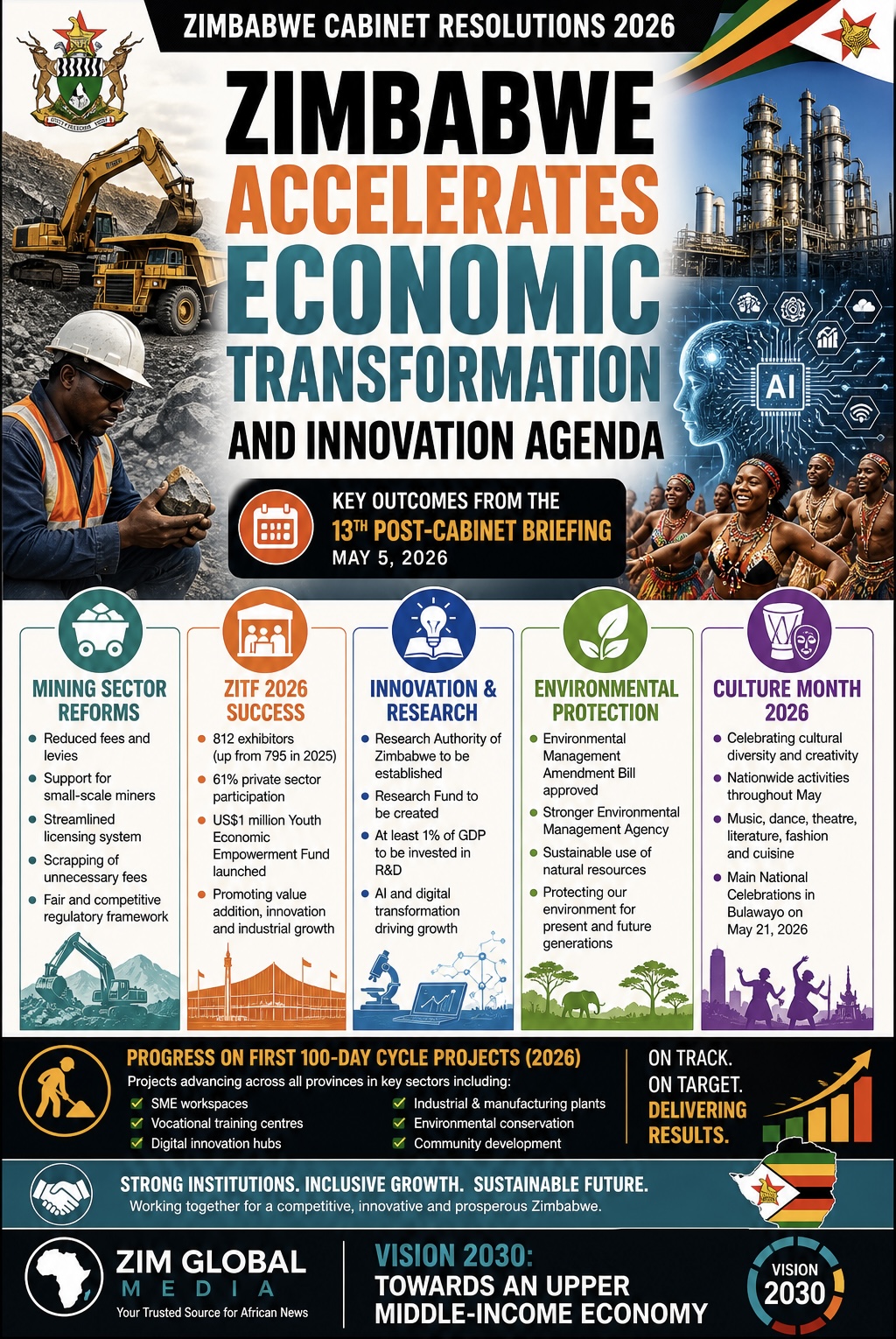
Harare – Zimbabwe’s latest Cabinet resolutions, as updated to the Nation following the 13th Cabinet meeting Chaired by the President, His Excellency Dr. ED. Mnangagwa reflect a government intent on accelerating economic reforms, strengthening institutional frameworks, and deepening cultural and technological transformation.
The outcomes of the Thirteenth Post-Cabinet Briefing, chaired by President Emmerson Mnangagwa on May 5, 2026, reveal a broad and ambitious agenda targeting mining sector reforms, industrial growth, research development, environmental protection, and national cultural promotion.
At the heart of the Cabinet’s decisions lies a renewed focus on improving the ease of doing business, particularly within the mining sector, which remains a cornerstone of Zimbabwe’s economy. Authorities have approved sweeping changes to licences, permits, levies, and fees, a move designed to reduce operational costs and enhance competitiveness. The reforms include the consolidation of overlapping regulatory requirements, removal of unnecessary fees, and the introduction of fairer pricing models that distinguish between large-scale operators and artisanal miners.
This restructuring is expected to breathe new life into small-scale mining activities, long viewed as a critical but under-supported segment of the industry. By pegging licence fees for smaller operators at significantly lower rates, the government is signaling a shift toward inclusivity and formalization of informal mining operations. The scrapping of certain fees, such as the Trading on Mining Location fee, and the reduction of others, including diamond processing licences, further underscores the reform-driven approach.
Beyond cost reduction, Cabinet also emphasized structural reforms within the mining sector, including the ongoing review of the Mines and Minerals Act and the rollout of a Mining Cadastre System. This digital system is expected to enhance transparency and efficiency in the allocation and management of mining rights, addressing long-standing concerns around accountability and governance.
Meanwhile, Zimbabwe’s industrial ambitions received a major boost following a successful 66th edition of the Zimbabwe International Trade Fair (ZITF), which Cabinet described as a resounding success. Held under the theme “Connected Economies, Competitive Industries,” the 2026 edition recorded increased participation, with 812 exhibitors compared to 795 the previous year. Notably, private sector participation accounted for the majority, signaling growing business confidence.
The fair served as a critical platform for policy dialogue and economic strategy, with several high-level engagements shaping the national development narrative. Among them was the Rural Industrialisation and Economic Empowerment Indaba, which explored ways to strengthen linkages between large industries and small enterprises, particularly in agro-processing and mineral beneficiation.
Youth empowerment also took center stage during the ZITF, with the launch of a US$1 million Youth Economic Empowerment Fund aimed at supporting young entrepreneurs. This initiative aligns with broader government efforts to address youth unemployment and foster innovation-driven enterprises.
Equally significant was the International Business Conference, where government reaffirmed its commitment to transitioning from raw material exports toward value addition and domestic manufacturing. This policy direction is seen as vital for boosting export earnings and creating sustainable jobs.
The Digital Economy Conference further reinforced Zimbabwe’s ambitions to harness technology as a driver of economic growth. Artificial Intelligence emerged as a focal point, with stakeholders highlighting its potential to revolutionize sectors such as agriculture, healthcare, education, and mining.
In the legislative arena, Cabinet approved two key Bills aimed at strengthening research and environmental governance. The Research Amendment Bill proposes the establishment of a Research Authority of Zimbabwe and a dedicated Research Fund, with a commitment to allocate at least 1% of the country’s GDP toward research and development.
This move is expected to significantly enhance Zimbabwe’s innovation ecosystem by promoting technological advancement and human capital development. By institutionalizing research funding, the government aims to position the country as a knowledge-driven economy capable of competing on the global stage.
Complementing this is the Environmental Management Amendment Bill, which seeks to align national legislation with constitutional environmental rights. The Bill is designed to strengthen the Environmental Management Agency and ensure sustainable use of natural resources for both present and future generations.
Zimbabwe’s growing influence on the continental stage was also evident in Cabinet’s approval to host a high-level meeting of African Registrar Generals and Civil Registration experts in June 2026. The event will bring together delegates from all 54 African countries, providing a platform for knowledge exchange and policy coordination on civil registration systems.
The country’s civil registry system has earned recognition for its efficiency and modernization, positioning Zimbabwe as a model for other African nations. Hosting this meeting not only enhances Zimbabwe’s diplomatic profile but also reinforces its role in shaping continental governance frameworks.
On the cultural front, Cabinet announced plans for the National Culture Month celebrations, set to take place throughout May, culminating in a major event in Bulawayo on May 21. Under the theme “Cultural Diversity and Creativity: Advancing Vision 2030,” the celebrations aim to promote national identity, unity, and economic growth through the arts.
Activities will span across all provinces and include music, dance, theatre, literature, fashion, and traditional cuisine. These events are expected to showcase Zimbabwe’s rich cultural heritage while also creating opportunities for artists and creative industries to thrive.
Progress on priority projects under the First 100-Day Cycle of 2026 also featured prominently in the Cabinet briefing. Across multiple ministries, projects are advancing steadily, with several nearing completion. These include SME workspaces, vocational training centers, digital innovation hubs, and environmental conservation initiatives.
Noteworthy developments include the near completion of the Gazaland SME workspace in Harare and the Bulawayo Textile Manufacturing Centre, both of which are expected to support industrial growth and job creation. Youth-focused projects, such as vocational training centers in Marondera and Maphisa, are also progressing well, reflecting a broader commitment to skills development.
Environmental projects, including fish conservation ponds and community nurseries, highlight the government’s efforts to balance economic growth with ecological sustainability. Meanwhile, industrial projects such as the clinker plant in Chegutu and the pine resin processing facility in Mutare demonstrate ongoing investment in value addition and manufacturing.
Taken together, the Cabinet resolutions paint a picture of a government pushing forward on multiple fronts—economic reform, industrialization, innovation, environmental stewardship, and cultural revival. While challenges remain, particularly in implementation and resource mobilization, the policy direction signals a determined effort to drive Zimbabwe toward its Vision 2030 goals.
As these initiatives unfold, their success will ultimately depend on effective execution, private sector collaboration, and sustained policy consistency. For now, the latest Cabinet decisions offer a clear indication of Zimbabwe’s strategic priorities and its ambition to position itself as a competitive and resilient economy in the region and beyond.