

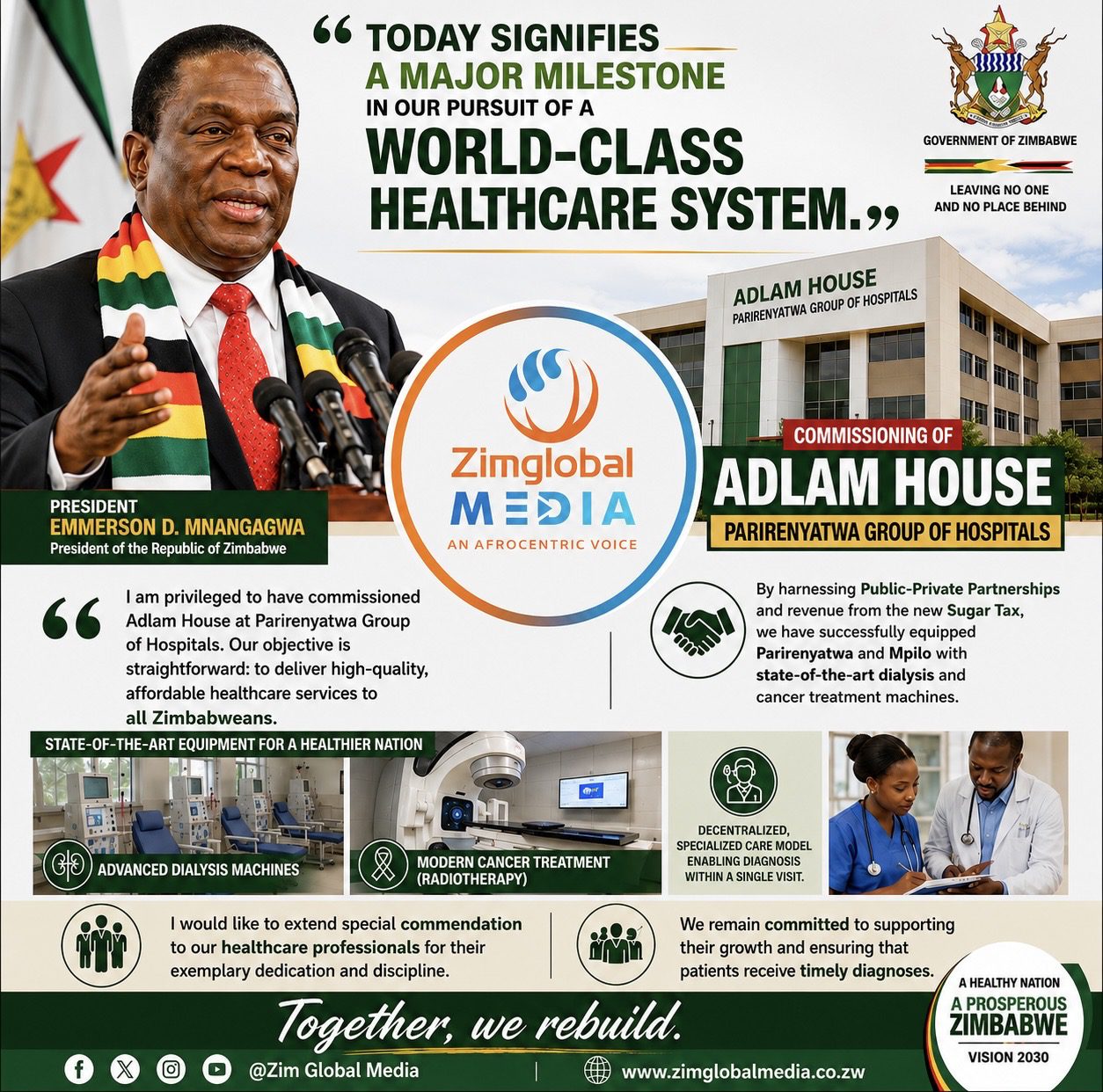
Harare – The President His Excellency Dr. Emmerson Dambudzo Mnangagwa earlier today, commissioned the newly refurbished Adlam House at Parirenyatwa Group of Hospitals, describing the development as a major milestone in Zimbabwe’s ongoing drive to build a modern, efficient and world-class healthcare system capable of serving all citizens.
Speaking during the official commissioning ceremony in Harare, the President said the completion of Adlam House symbolised Government’s commitment to strengthening the country’s public health institutions and ensuring that quality healthcare becomes accessible and affordable for every Zimbabwean regardless of social status or geographical location.
“Today signifies a major milestone in our pursuit of a world-class healthcare system,” President Mnangagwa said.
“I am privileged to have commissioned Adlam House at Parirenyatwa Group of Hospitals. Our objective is straightforward: to deliver high-quality, affordable healthcare services to all Zimbabweans.”
The commissioning comes at a time when Government is intensifying efforts to modernise the country’s health sector through infrastructure rehabilitation, acquisition of advanced medical equipment and improved service delivery across central, provincial and district hospitals.
President Mnangagwa said the Second Republic had adopted a practical and results-oriented approach to healthcare transformation through strategic investments and partnerships designed to improve patient outcomes and reduce dependence on foreign medical referrals.
Central to this strategy, he said, has been the use of Public-Private Partnerships, which are increasingly becoming a key pillar in Zimbabwe’s healthcare financing and infrastructure development model.
The President revealed that resources generated through the recently introduced Sugar Tax, combined with support from private sector partners, had already enabled Government to procure state-of-the-art dialysis and cancer treatment machines for both Parirenyatwa Group of Hospitals in Harare and Mpilo Central Hospital in Bulawayo.
The acquisition of the specialised machines is expected to significantly improve the country’s capacity to manage chronic kidney disease and cancer, two conditions that have increasingly placed pressure on Zimbabwe’s healthcare system in recent years.
Health experts have long raised concerns over the limited availability of dialysis equipment and radiotherapy services in public hospitals, forcing many patients to seek costly treatment abroad or through expensive private institutions.
Government officials believe the new equipment will not only improve access to life-saving treatment but also reduce waiting times and ease congestion in referral hospitals.
President Mnangagwa said the investments demonstrated Government’s determination to ensure that Zimbabweans receive specialised treatment within the country instead of travelling to neighbouring nations for medical care.
“Our focus is on building a healthcare system that responds effectively to the needs of our people,” he said.
“We are modernising our institutions and decentralising specialised services so that diagnosis and treatment can be achieved efficiently and within the shortest possible time.”
The President also outlined Government’s vision of a decentralised healthcare delivery framework that allows patients to access specialised medical services closer to their communities.
Under the model, provincial and district hospitals are expected to gradually receive upgraded diagnostic and treatment facilities aimed at reducing pressure on major referral centres while improving early disease detection.
Authorities say the decentralised system will particularly benefit patients in rural and remote areas who often travel long distances to Harare or Bulawayo for specialist treatment.
President Mnangagwa stressed that the goal was to establish a patient-centred healthcare model where individuals can receive comprehensive diagnosis and treatment within a single hospital visit.
Health sector reforms introduced under the Second Republic have increasingly focused on improving efficiency, reducing delays and restoring public confidence in state healthcare institutions.
The commissioning of Adlam House is also expected to strengthen Parirenyatwa Group of Hospitals’ capacity as Zimbabwe’s largest referral medical institution.
Over the years, the hospital has faced numerous challenges including ageing infrastructure, shortages of critical equipment and increasing patient demand. However, ongoing rehabilitation projects and recent investments are beginning to transform sections of the institution into modern healthcare facilities capable of delivering advanced medical services.
President Mnangagwa paid tribute to healthcare workers across the country, acknowledging the sacrifices and dedication shown by doctors, nurses, technicians and support staff under often difficult conditions.
“I would like to extend special commendation to our healthcare professionals for their exemplary dedication and discipline,” he said.
The President said Government remained committed to improving working conditions within the health sector and supporting the professional development of healthcare personnel through training, capacity building and access to modern technologies.
Zimbabwe’s healthcare workers have frequently been recognised for their resilience, particularly during periods of economic difficulty and public health emergencies that placed immense strain on medical institutions.
Analysts say improving staff morale and investing in professional growth will be critical in addressing brain drain within the sector, where many skilled healthcare workers have sought opportunities outside the country.
Government officials believe ongoing infrastructure upgrades and equipment modernisation programmes could help retain skilled personnel while attracting specialists back into the public healthcare system.
The commissioning ceremony attracted senior Government officials, healthcare administrators, medical practitioners and representatives from the private sector who have partnered with Government on various health projects.
Observers described the event as another indication of Government’s broader national development agenda under Vision 2030, which seeks to transform Zimbabwe into an upper middle-income economy with strong social services and modern infrastructure.
Healthcare has emerged as one of the key sectors targeted for accelerated investment under the programme, alongside education, transport, energy and industrial development.
Recent years have seen increased focus on hospital rehabilitation projects, procurement of ambulances, upgrading of rural clinics and expansion of specialist services across the country.
The introduction of the Sugar Tax has also become a major talking point within public health circles. Authorities say revenue collected through the levy is being channelled toward strengthening the health sector, particularly in combating non-communicable diseases such as diabetes, hypertension and cancer.
Public health experts argue that while sugary beverages contribute to rising lifestyle-related illnesses, the tax can simultaneously create a sustainable funding stream for medical infrastructure and treatment services.
For many Zimbabweans, the commissioning of Adlam House represents more than the opening of another hospital facility. It reflects growing hope that public healthcare institutions can once again provide efficient, affordable and dignified treatment to ordinary citizens.
Patients and families who have endured long waiting periods, equipment shortages and costly medical referrals are expected to benefit from the new investments being rolled out within major hospitals.
As Zimbabwe continues to rebuild and modernise its healthcare sector, Government says partnerships between the State, private sector and healthcare professionals will remain essential in achieving long-term transformation.
President Mnangagwa ended his address with a message of unity and determination, emphasising that national progress depends on collective effort and shared responsibility.
“Together, we rebuild,” he declared.