
Opinion – For generations, Africa’s story has too often been written by outsiders. From colonial era propaganda to modern international media framing, the continent has frequently been portrayed through lenses of poverty, war, disease and instability while its innovation, resilience, culture and intellectual contributions have been pushed to the margins.
Today, in the digital age, the battle for Africa’s narrative has entered a new and more dangerous frontier. Social media platforms, artificial intelligence systems, streaming services and global digital newsrooms now shape how billions of people perceive nations, cultures and peoples in real time. The question confronting Africa is no longer merely political or economic. It is civilisational. If Africans do not control their own narrative in the digital era, they risk becoming digitally colonised in the same way they were politically colonised in the past.
The digital revolution has created unprecedented opportunities for Africa to speak directly to the world without relying on traditional Western gatekeepers. Smartphones, podcasts, independent online newspapers, YouTube channels and social media platforms have empowered ordinary Africans to tell their own stories from their own perspectives. Across the continent, a new generation of journalists, filmmakers, influencers, historians and cultural activists are reclaiming African identity online.
From Zimbabwe to Nigeria, Kenya to South Africa, digital platforms are becoming battlegrounds for cultural preservation, political influence and economic power. African creators are producing content that celebrates indigenous languages, traditional knowledge systems, local entrepreneurship and African excellence. For the first time in history, a rural youth with a smartphone can challenge global misinformation and contribute to shaping the global discourse.
However, despite these gains, Africa remains dangerously vulnerable within the global digital ecosystem. Most social media platforms used by Africans are foreign owned. The algorithms that determine what content becomes visible are controlled outside the continent. The data generated by millions of Africans is stored, monetised and analysed by foreign corporations. This creates a modern imbalance of power where Africa consumes digital products and narratives created elsewhere while having limited control over how it is represented.
This imbalance has serious consequences. During times of political tension, conflict or elections, misinformation about African countries can spread globally within minutes. International headlines often amplify crises while ignoring stories of progress, innovation and community resilience. A single distorted viral video can shape perceptions of an entire nation. Unfortunately, African voices are often underrepresented in correcting these narratives.
The issue extends beyond politics and news. African culture itself is increasingly at risk of digital dilution. Young Africans are growing up in online spaces dominated by foreign entertainment, foreign values and foreign lifestyles. While cultural exchange is natural in a globalised world, the overwhelming dominance of Western digital culture has created identity struggles among many African youths who are slowly disconnecting from their languages, traditions and historical consciousness.
This is why Africa’s control of its narrative is not simply about public relations. It is about sovereignty, identity and survival.
Countries that control their narratives influence global investment, tourism, diplomacy and cultural respect. Nations that fail to define themselves are often defined by others. In Africa’s case, the consequences of externally imposed narratives have historically justified exploitation, intervention and economic marginalisation.
The digital age therefore demands a new form of African liberation, one centred on information sovereignty and cultural confidence.
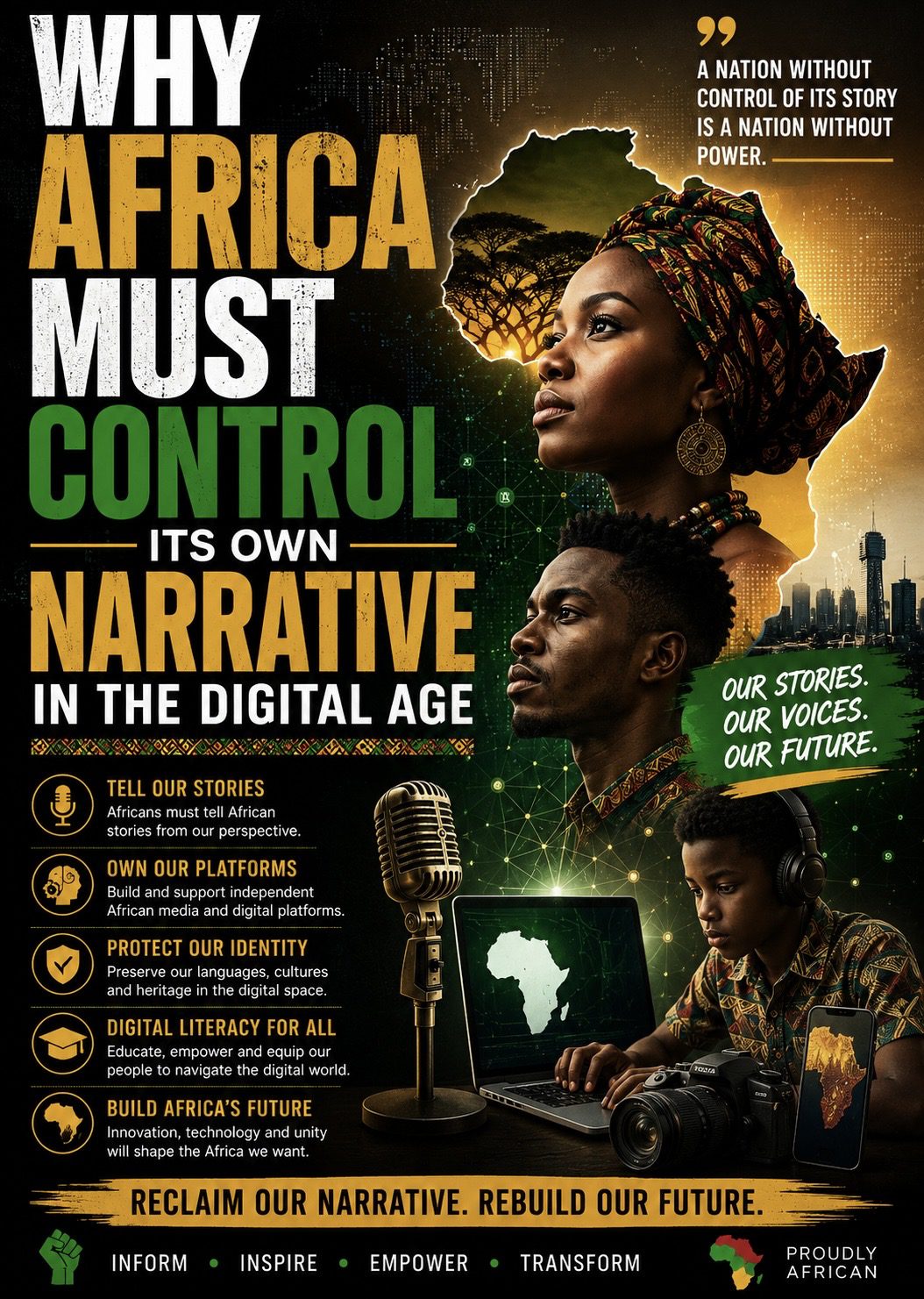
Africa must invest heavily in strengthening independent African media institutions capable of competing on the global stage. Local newsrooms need technological support, training and sustainable funding models to reduce dependency on foreign interests. African governments, private sectors and educational institutions must recognise media as a strategic national asset rather than merely an industry.
At the same time, digital literacy must become a continental priority. Citizens need the ability to critically analyse online information, identify misinformation and understand how algorithms influence perception. Without digital literacy, societies become vulnerable to manipulation both internally and externally.
The rise of artificial intelligence adds another urgent dimension to the discussion. AI systems are trained using massive datasets that often underrepresent African languages, cultures and realities. If Africa does not actively participate in AI development, future technologies may continue reproducing harmful stereotypes and biases about the continent.
Already, many African languages have limited digital presence compared to global languages. This creates a future where millions of Africans may find themselves excluded from emerging technologies because their languages and cultural contexts were not prioritised during development.
Africa cannot afford to remain a passive consumer in the AI revolution. Universities, innovators and policymakers must collaborate to build African centred digital technologies that reflect African realities and priorities.
There is also an urgent need to preserve African history and heritage digitally. Many African historical archives remain stored in foreign institutions while countless oral traditions risk disappearing as older generations pass away. The digital era offers Africa a unique opportunity to document indigenous knowledge, liberation histories, cultural practices and traditional philosophies for future generations.
Platforms dedicated to African storytelling, documentaries, podcasts and historical education must therefore be supported and expanded. Young Africans should be encouraged to become creators, researchers and custodians of their own heritage.
Importantly, controlling Africa’s narrative does not mean rejecting global engagement or isolating the continent from the world. Rather, it means engaging the world from a position of dignity, confidence and authenticity. Africa must speak for itself instead of constantly being spoken for.
Encouragingly, signs of this transformation are already visible. African music now dominates global charts. African fashion influences international runways. African filmmakers are gaining worldwide recognition. African writers, academics and digital creators are increasingly shaping global conversations. The world is beginning to listen to African voices not as subjects of discussion but as authors of their own stories.
Yet much more remains to be done.
The future of Africa in the digital age will not only be determined by natural resources, infrastructure or military strength. It will also be determined by who controls information, culture and perception. In many ways, the struggle for narrative control is the new frontline of African independence.
Kwame Nkrumah once warned that political independence without economic independence would remain incomplete. In today’s world, one might add that economic independence without narrative independence is equally fragile.
Africa’s greatest resource has always been its people, its cultures and its stories. Those stories deserve to be told truthfully, proudly and by Africans themselves.
The digital age has given Africa the tools. What remains is the collective determination to use them.