

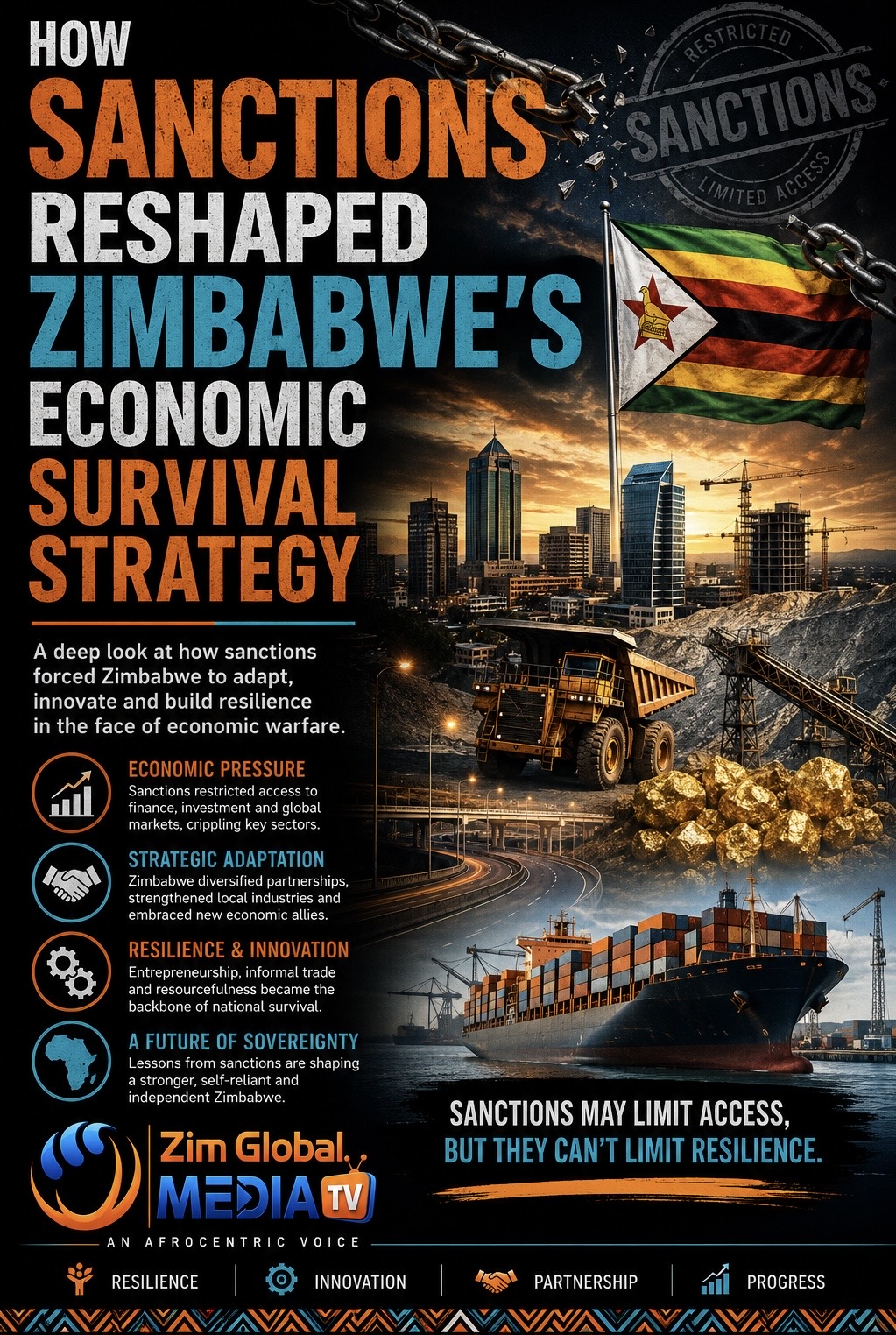
Opinion – For more than two decades, Zimbabwe has existed under the shadow of Western sanctions, a reality that has profoundly shaped the country’s political discourse, economic direction and national psychology. While critics and supporters continue to debate the precise impact of these measures, one undeniable fact remains: sanctions forced Zimbabwe to fundamentally rethink its economic survival strategy.
What emerged from this prolonged period of economic pressure was not merely a story of hardship and isolation, but also one of adaptation, resilience and strategic reorientation. Zimbabwe’s experience under sanctions became a defining chapter in the broader African conversation about sovereignty, economic independence and resistance to external pressure.
The sanctions imposed by the United States and several Western countries in the early 2000s came during a turbulent period marked by the fast track land reform programme. The measures targeted key political leaders, state institutions and sectors of the economy. Western governments argued that the sanctions were intended to promote democracy and accountability. However, Zimbabwe consistently maintained that the measures were punitive and designed to weaken the country economically following the redistribution of land from white commercial farmers to the black majority.
Regardless of political interpretations, the economic consequences were severe. International credit lines dried up. Investor confidence weakened dramatically. Access to global financial systems became increasingly restricted. Many international companies scaled down operations while development assistance declined in several sectors.
Zimbabwe found itself navigating a hostile international financial environment at a time when the country was already dealing with internal economic challenges. Inflation spiralled, industrial production declined and unemployment surged. The economy entered one of the most difficult periods in the nation’s post independence history.
Yet amid this crisis, Zimbabwe was compelled to rethink the foundations of its economy and its place within the global system.
One of the most significant shifts was Zimbabwe’s gradual move away from overdependence on Western financial institutions and markets. As relations with Western powers deteriorated, the country increasingly adopted the “Look East Policy,” strengthening economic and diplomatic ties with countries such as China, Russia, India and other emerging economies.
China in particular became a major strategic partner in infrastructure development, mining investment and trade cooperation. Chinese funded projects began reshaping Zimbabwe’s infrastructure landscape through the construction of airports, power stations, roads and parliamentary buildings. While debates around the long term implications of Chinese involvement continue, there is little doubt that the partnership provided Zimbabwe with critical alternatives during a period of international isolation.
Sanctions also accelerated Zimbabwe’s push toward resource based survival strategies. Mining became one of the country’s most important economic pillars, with gold, platinum, lithium and diamonds emerging as key sources of foreign currency generation. Faced with limited access to external financing, Zimbabwe increasingly relied on its natural resources to sustain economic activity and government operations.
Agriculture, despite facing immense challenges following land reform and climate shocks, also underwent transformation. The redistribution of land created a new class of black commercial and small scale farmers who gradually became central players in national food production. Though productivity initially declined, the long term objective of correcting colonial land imbalances remained politically significant within Zimbabwe’s national narrative.
Importantly, sanctions forced Zimbabwe to develop informal economic resilience mechanisms rarely discussed in conventional economic analysis. Millions of Zimbabweans adapted through cross border trade, diaspora remittances, small scale entrepreneurship and informal sector innovation. The informal economy became a lifeline for ordinary citizens and a parallel economic system that kept communities functioning even during periods of hyperinflation and financial instability.
Zimbabwe’s diaspora also emerged as one of the country’s most critical economic support systems. Remittances from Zimbabweans living abroad became a major source of household income and foreign currency inflows. Families survived through transnational economic networks that connected Zimbabweans across South Africa, the United Kingdom, Botswana, Australia and beyond.
In many ways, sanctions unintentionally strengthened Zimbabwean entrepreneurial resilience. Citizens became highly adaptive, resourceful and innovative in navigating economic uncertainty. Informal markets, mobile money systems and community survival networks became deeply embedded within the country’s economic culture.
At the same time, the sanctions era exposed the dangers of economic dependency and the vulnerabilities of African states within the global financial order. Zimbabwe’s exclusion from certain international financial mechanisms highlighted how geopolitical tensions can quickly disrupt national economies heavily integrated into Western controlled systems.
This reality strengthened growing calls across Africa for greater economic self reliance, regional trade integration and alternative financial structures. Zimbabwe increasingly positioned itself within broader Pan African discussions around de dollarisation, BRICS cooperation and South South partnerships.
The emergence of the African Continental Free Trade Area also aligns with lessons many African countries have drawn from Zimbabwe’s experience. The need for intra African trade, local industrialisation and regional value chains has become increasingly urgent in a world where global economic power is rapidly shifting.
However, it would be incomplete to romanticise Zimbabwe’s sanctions experience without acknowledging the immense suffering endured by ordinary citizens. Economic instability eroded savings, weakened public services and contributed to rising poverty levels over many years. Hospitals, schools and industries faced enormous strain. Many skilled professionals emigrated in search of better opportunities abroad.
The sanctions period also coincided with governance challenges, corruption concerns and policy inconsistencies that further complicated economic recovery efforts. Therefore, while sanctions undoubtedly affected Zimbabwe’s economy, internal factors also played a significant role in shaping outcomes.
Nonetheless, Zimbabwe’s response to sanctions offers important lessons about national resilience under pressure. Rather than collapsing entirely, the country adapted by diversifying alliances, strengthening informal survival systems and seeking alternative economic pathways.
Today, Zimbabwe continues pursuing economic recovery and re engagement while simultaneously maintaining its emphasis on sovereignty and self determination. The country’s economic strategy increasingly focuses on mining expansion, agriculture revival, infrastructure modernisation, industrialisation and regional integration.
The rise of lithium mining linked to the global green energy transition presents new economic opportunities. Infrastructure development projects continue reshaping key sectors while digital innovation and youth entrepreneurship are becoming increasingly important components of the economy.
For many Zimbabweans, the sanctions era became more than a political dispute. It became a national test of endurance and identity. It forced difficult conversations about what genuine independence means in a globalised economic system still shaped by unequal power relations.
In the end, sanctions did not simply punish Zimbabwe. They transformed the country’s economic behaviour, diplomatic orientation and survival instincts. Zimbabwe learned, often painfully, that resilience is not built during times of comfort but during moments of prolonged adversity.
As Africa navigates an uncertain global future marked by geopolitical competition, economic fragmentation and technological transformation, Zimbabwe’s experience serves as both a warning and a lesson. Nations that fail to build economic resilience and strategic independence remain vulnerable to external shocks. But nations that adapt, innovate and maintain confidence in their sovereignty may yet find strength even in adversity.