Zim-Russia Ties Deepen as President Mnangagwa Bids Farewell to Ambassador Krasilnikov
4 min read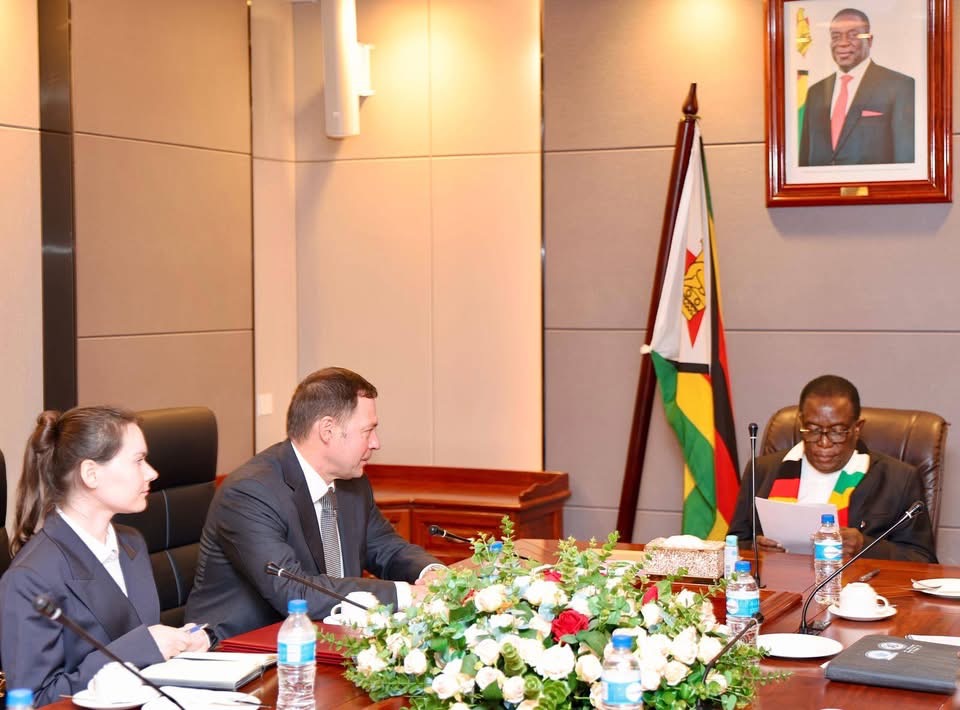
Harare – In a moment that reflected both gratitude and forward-looking diplomacy, President Emmerson Mnangagwa earlier today, hosted His Excellency Mr. Nikolai Krasilnikov at his Munhumutapa Offices, marking the end of a six-and-a-half-year diplomatic journey that has helped redefine relations between Zimbabwe and Russia.
The meeting was not merely ceremonial. It was a powerful reflection of a relationship rooted in history, tested through time, and now evolving into a modern partnership shaped by shared aspirations for sovereignty, development and global equity.
Speaking after the engagement, President Mnangagwa described Ambassador Krasilnikov’s tenure as impactful, underscoring how the envoy played a central role in strengthening political dialogue and unlocking economic cooperation between the two nations.
“Zimbabwe and Russia have walked a long road together, and under Ambassador Krasilnikov’s watch, that road has widened into a highway of opportunity,” President Mnangagwa said, his remarks carrying the tone of a leader conscious of both history and destiny.
From the liberation struggle to present-day statecraft, the bond between Harare and Moscow has never been accidental. It has been deliberate, forged in the fires of resistance and sustained through a mutual understanding of what it means for nations to assert their place in a world often shaped by unequal power dynamics.
Ambassador Krasilnikov’s tenure came at a defining period in Zimbabwe’s re-engagement thrust, where the Second Republic has actively sought to build bridges beyond traditional alliances. In this evolving diplomatic landscape, Russia has stood out not only as a partner, but as a consistent ally.
At the heart of this partnership lies something more than agreements signed in boardrooms. It is about impact on the ground. It is about the ordinary Zimbabwean citizen.
One of the most visible symbols of this cooperation is the National Ambulance Project, a life-saving initiative that has transformed emergency healthcare delivery across the country. Through Russian support, Zimbabwe has been able to expand its ambulance fleet, bringing critical services closer to communities that were once beyond the reach of timely medical intervention.
In rural districts, where distance has often meant the difference between life and death, the sound of an approaching ambulance now carries a new meaning. It is the sound of a nation rising, supported by partnerships that speak to real needs.
President Mnangagwa was unequivocal in acknowledging this contribution.
“The tangible outcomes of this partnership are evident in sectors that matter most to our people. From infrastructure to healthcare, the cooperation we have built is changing lives,” he said.
Yet the Zimbabwe-Russia relationship does not end in healthcare. It stretches into the depths of the earth, into the mining sector where both nations are exploring value-driven partnerships, particularly in platinum and other strategic minerals. It extends into energy, agriculture, education and technology, areas that are central to Zimbabwe’s Vision 2030.
What makes this relationship distinct is its alignment with Africa’s broader awakening. Across the continent, there is a growing insistence on partnerships that are respectful, balanced and mutually beneficial. Zimbabwe’s engagement with Russia reflects this shift, where collaboration is no longer defined by dependency, but by shared interest and mutual gain.
Ambassador Krasilnikov’s work also strengthened people-to-people ties. Zimbabwean students have continued to access educational opportunities in Russia, while cultural exchanges have helped bridge understanding between the two nations. These softer dimensions of diplomacy often go unnoticed, yet they form the foundation upon which enduring relationships are built.
As he prepares to leave Zimbabwe, Ambassador Krasilnikov does so with a legacy that is both visible and measurable. Roads of cooperation have been paved. Channels of dialogue have been strengthened. Trust has been deepened.
But perhaps more importantly, he leaves behind a relationship that is no longer fragile or tentative. It is confident. It is evolving. It is ready for its next chapter.
President Mnangagwa’s farewell message carried this sense of continuity.
“As Ambassador Krasilnikov prepares to leave, we anticipate even more remarkable achievements in our enduring friendship,” he said.
In the language of African diplomacy, such words are not mere courtesy. They are a commitment.
Zimbabwe today stands at a crossroads where international partnerships must translate into national transformation. The country’s Vision 2030 agenda is ambitious, seeking to uplift livelihoods, industrialise the economy and reposition Zimbabwe as a competitive player on the global stage.
To achieve this, Harare is not looking for charity. It is seeking cooperation anchored in respect, investment anchored in value and diplomacy anchored in truth.
Russia, in this context, has proven to be a partner willing to engage on those terms.
As global geopolitics continue to shift, with new centres of power emerging and old alliances being redefined, Zimbabwe’s strategy of diversification appears not only timely but necessary. The relationship with Russia is a clear example of how nations of the Global South can work together to shape their own futures.
For many Zimbabweans, the significance of this moment goes beyond diplomacy. It is about dignity. It is about rewriting the narrative of a nation that has often been misunderstood, yet remains resolute in its pursuit of progress.
Ambassador Krasilnikov’s departure may mark the end of a diplomatic posting, but it does not mark the end of a journey. Instead, it signals the continuation of a story still being written, one where Zimbabwe and Russia walk side by side, not as distant allies, but as partners in a shared vision.